A parent’s guide to evaluating a study-abroad plan
What should parents verify before agreeing to overseas study?
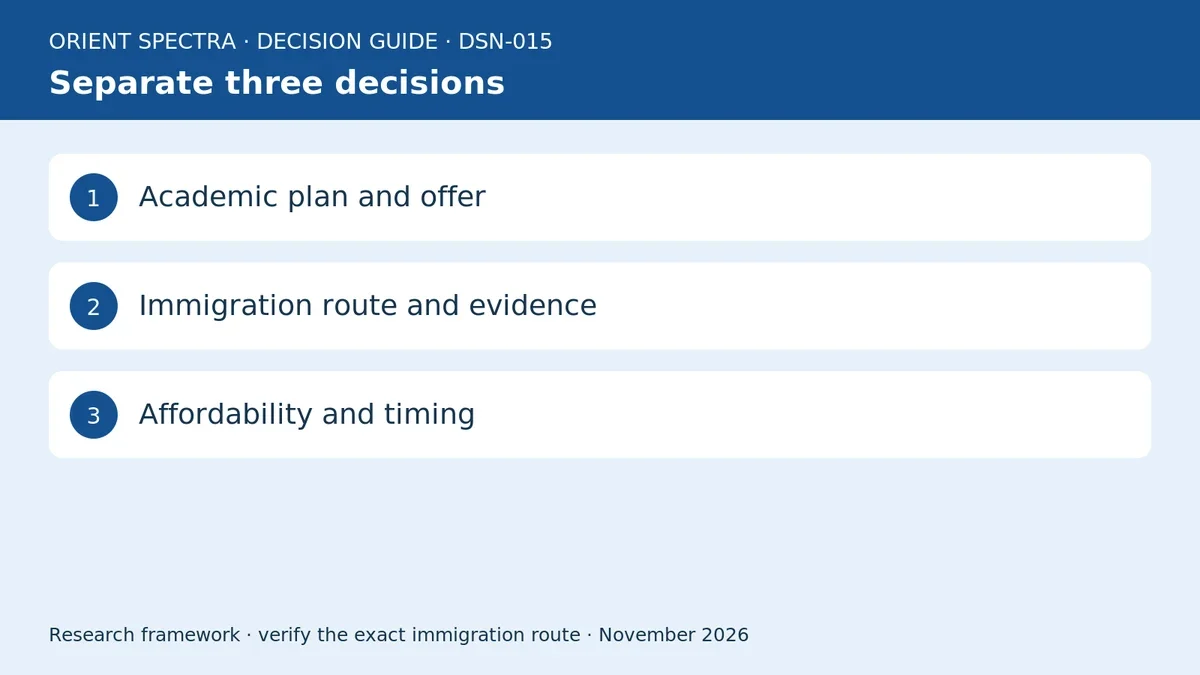
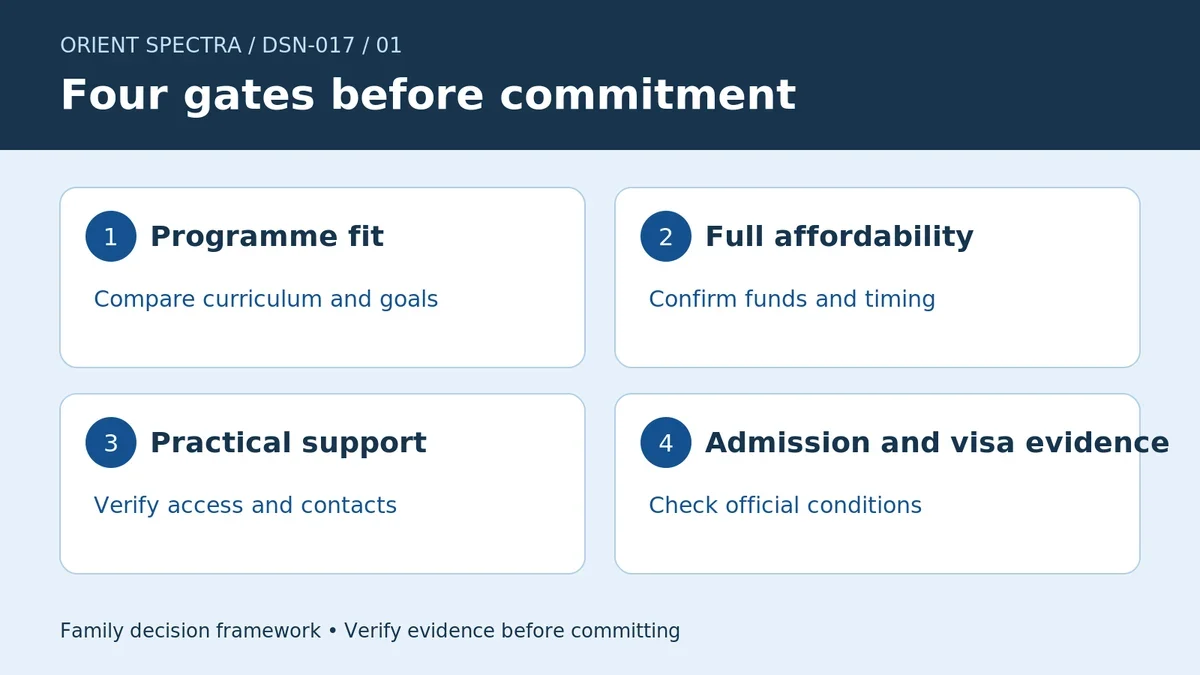
Parents of Indian students should evaluate a study-abroad plan against four kinds of evidence: whether the programme suits the student’s academic and career goals, whether the family can finance the entire commitment, whether practical support is available, and whether the admission and immigration requirements can be met. Compare written evidence for realistic alternatives before committing money, and agree on a fallback plan together.
Researched: November 2026.
Start with a family decision, not a destination
The decision is whether a particular course, institution, campus and intake make sense for this student at this point in their education. A country preference may be a useful starting point, but it cannot substitute for evaluating a specific offer. A popular destination may not suit the subject the student wants to study or the family’s financing arrangements. Equally, an unfamiliar destination should not be ruled out solely because relatives have not studied there.
Ask the student to explain what they want to learn and why. Parents can identify financial limits, practical concerns and questions that require independent verification. Both should agree on the evidence needed before making a commitment. The aim is not to remove every uncertainty; it is to avoid commitments that depend on untested assumptions.
For a structured example of the application journey, the U.S. Department of State’s EducationUSA guidance separates researching options from financing studies and later application steps. The order is a useful reminder to compare alternatives before paying for them. See EducationUSA’s study planning guide.
Which details about the student change the decision?
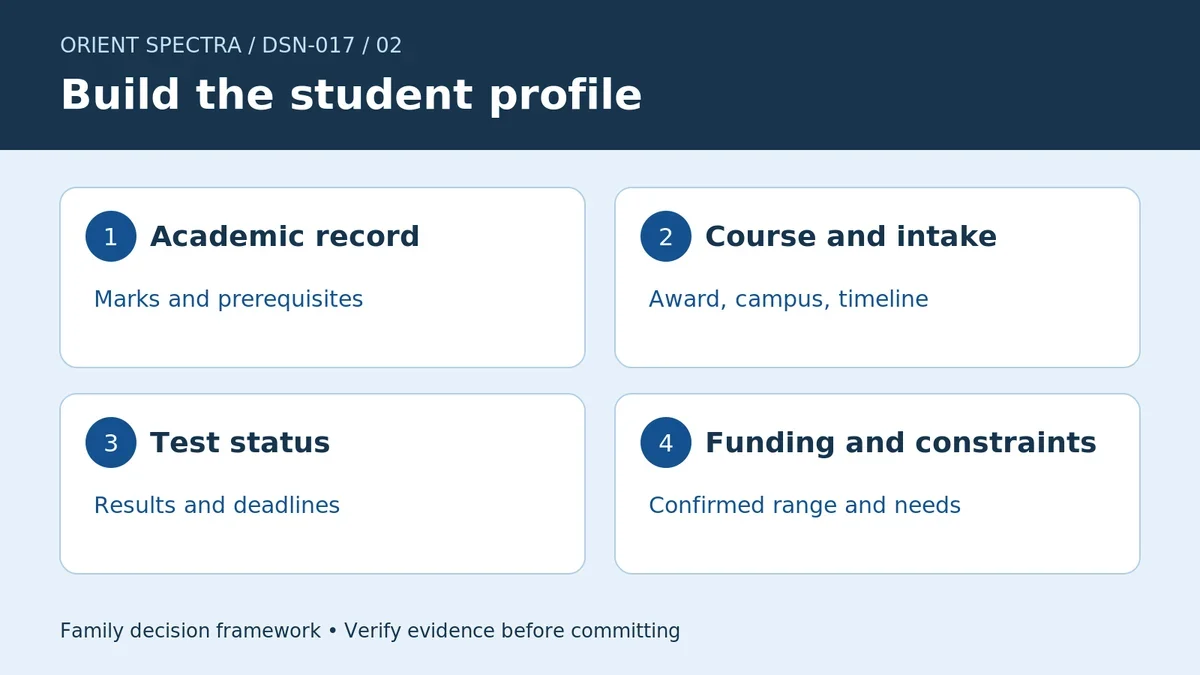
Write a one-page profile together. Include completed qualifications, marks or grades, subject prerequisites, English test status, preferred field, study level, intended intake, available funding and any personal constraints the student wants considered. A student who needs a particular prerequisite may have fewer viable options than someone comparing two courses for which they already meet the academic criteria.
Distinguish the student’s ambition from the conditions that must be satisfied. For example, a student interested in a specialised master’s programme should identify the modules and prior knowledge required rather than relying on the programme title alone. If the course is intended to lead to a regulated occupation, investigate the professional recognition process separately from academic admission. Ask the relevant regulator about the qualification, jurisdiction and intended practice pathway.
Keep a separate list of unresolved questions. If a test result is pending, record the intended test date and the institution’s published deadline. If a financial sponsor has not committed, treat the funding as uncertain. This prevents a shortlist from becoming a commitment before the family has sufficient evidence.
1. How can a family verify programme fit?
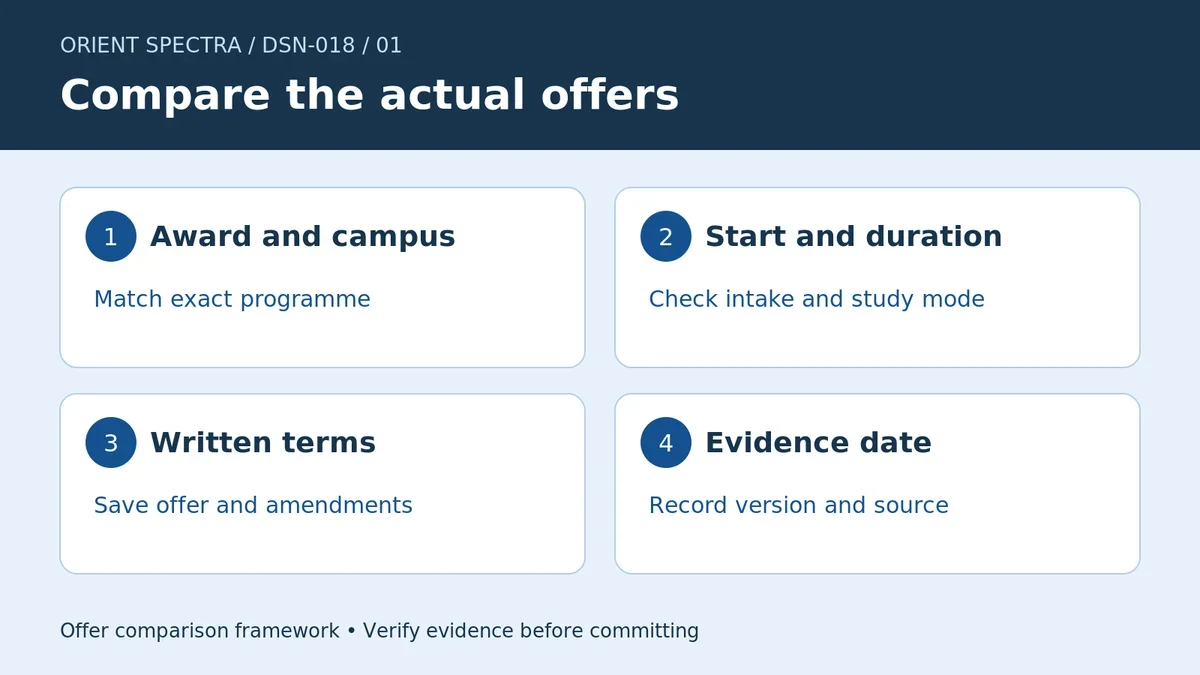
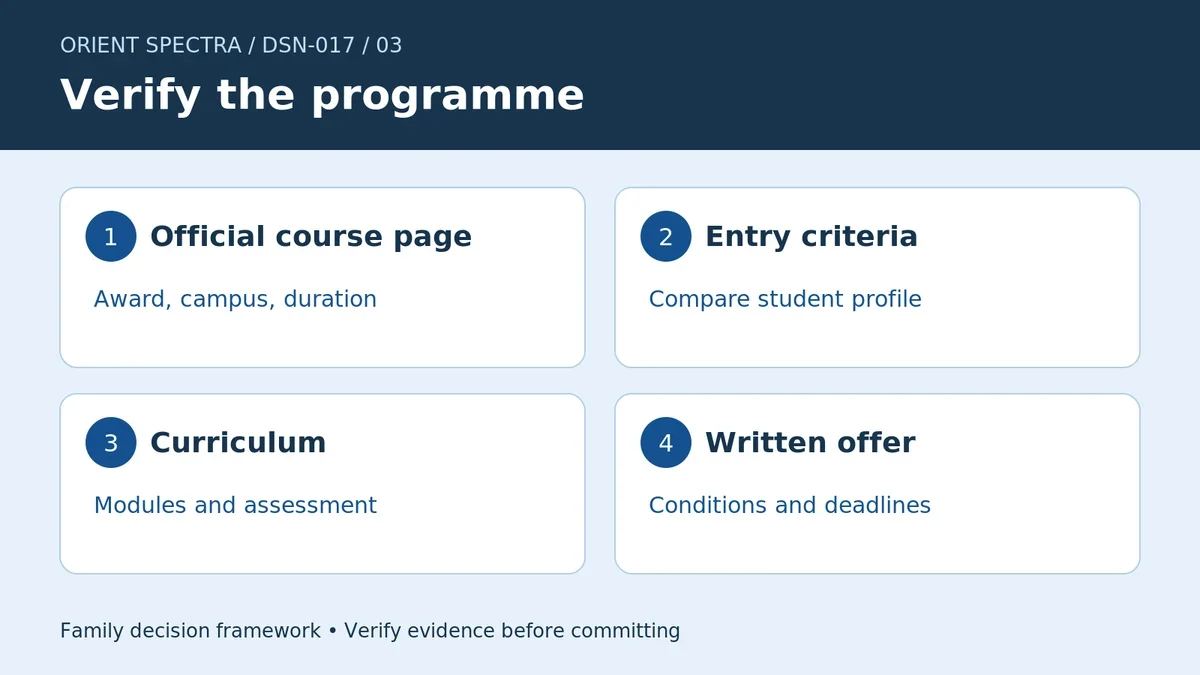
Open the official programme page and confirm the exact course title, award, campus, duration, teaching arrangements and intake. Compare entry criteria with the student’s documented profile. Look at compulsory modules, available electives, assessment methods and the requirements for completion. A brochure or search catalogue can help identify a course, but the official programme information and written offer should guide the final decision.
Ask the institution for clarification if a module, placement, accreditation or progression arrangement is important but not described clearly. Do not assume that a placement is guaranteed because a programme mentions industry exposure. Where possible, compare an alternative programme with similar learning goals. Record why one option is better for this particular student, not simply why its institution appears more familiar.
Country-specific official registers can help with the initial checks. For Australia, the Department of Education directs international students to the Commonwealth Register of Institutions and Courses for Overseas Students (CRICOS) to look up providers and courses. Registration is a separate consideration from suitability or professional recognition. See Before studying in Australia.
2. What is the full financial commitment?
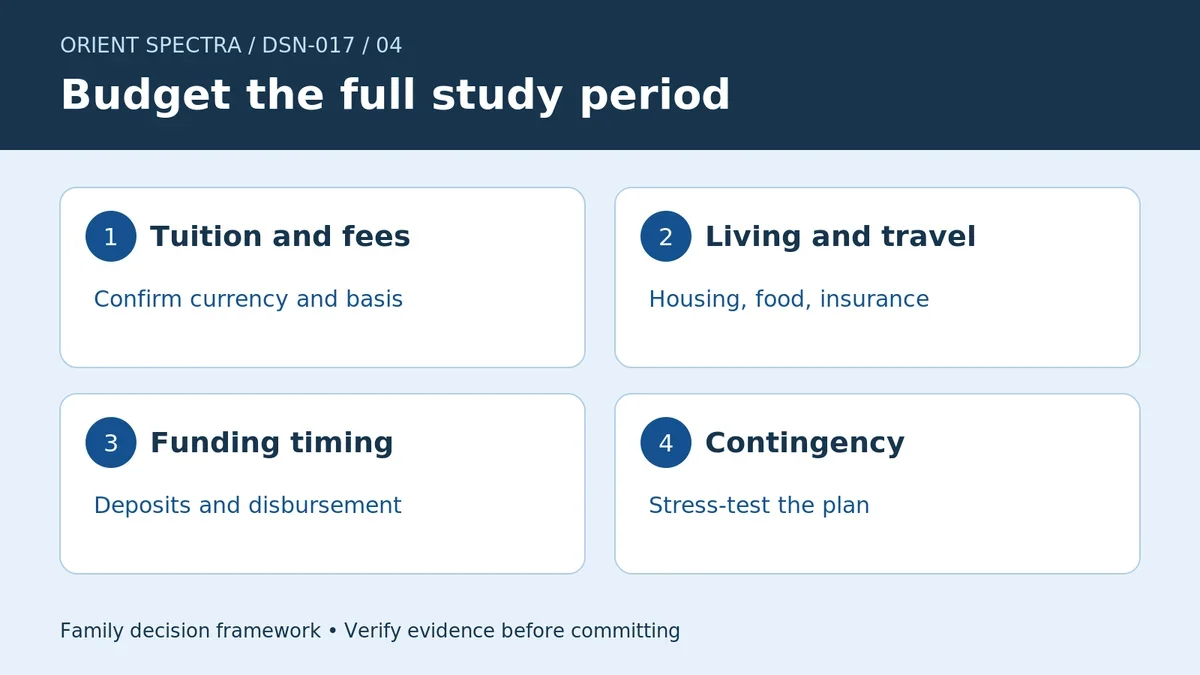
Create a cash-flow schedule for the entire planned study period, rather than comparing annual tuition alone. Include tuition, compulsory charges, accommodation deposits and rent, food, transport, insurance or health-related charges where applicable, application and immigration fees, travel and a contingency reserve. Confirm the currency and whether the institution quotes fees per year, per credit or for the entire course. Record when each payment is due.
For example, consider two hypothetical offers. Offer A has lower tuition but requires an expensive housing arrangement; Offer B has higher tuition but a more affordable confirmed housing option. Compare the total cost, timing of deposits and refund conditions rather than deciding from the tuition difference. These are illustrative situations, not estimates for any country or institution.
Keep scholarships separate from confirmed funds until the award, conditions and amount are documented. Similarly, plan without depending on future student earnings. Even where work is permitted, actual employment and earnings are uncertain. Ask the lender about disbursement dates, interest, repayment conditions and whether the family could manage if circumstances changed. Test whether the plan is still affordable if exchange rates move against the family or the course takes longer than expected.
Immigration financial requirements and the family’s actual spending budget are different checks. For the UK Student route, the government provides specific guidance on required financial evidence. Check the applicable rules at the time of application rather than copying a figure from an old checklist. See UK financial evidence guidance.
3. What support arrangements should parents examine?
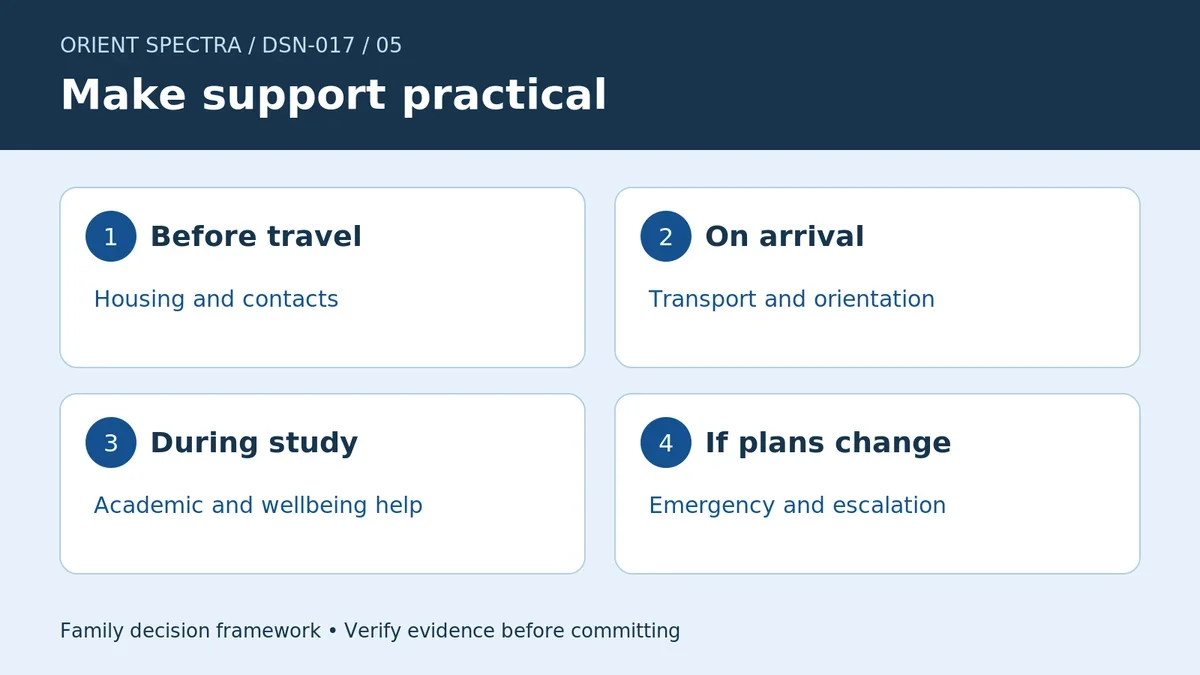
Ask the institution about international student orientation, academic advising, housing support, wellbeing services, accessibility arrangements and emergency contact procedures. Identify which services are available to the student’s cohort, how they are accessed, whether charges apply and what support is available outside normal office hours. A listed service is not proof that it will meet every individual need.
Discuss how the student will handle travel from the airport, initial accommodation, communication with family and access to local assistance. If the student has a specific accessibility or wellbeing requirement, they can contact the relevant service privately and request written clarification before committing. Parents and adult students should agree on how information will be shared, respecting the student’s privacy and independence.
Australia’s Department of Education provides support information for international students, illustrating why families should consult official student-support resources alongside university information. Support arrangements and protections differ by jurisdiction; no service can guarantee a risk-free experience.
4. What risks should be investigated before payment?
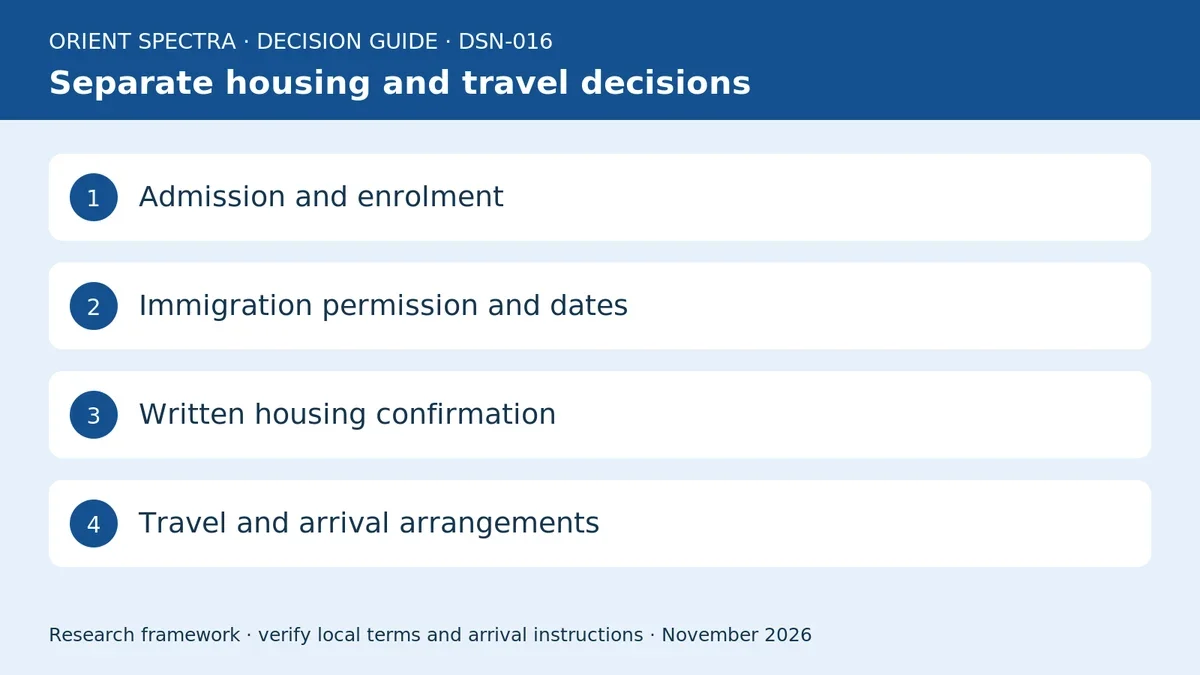
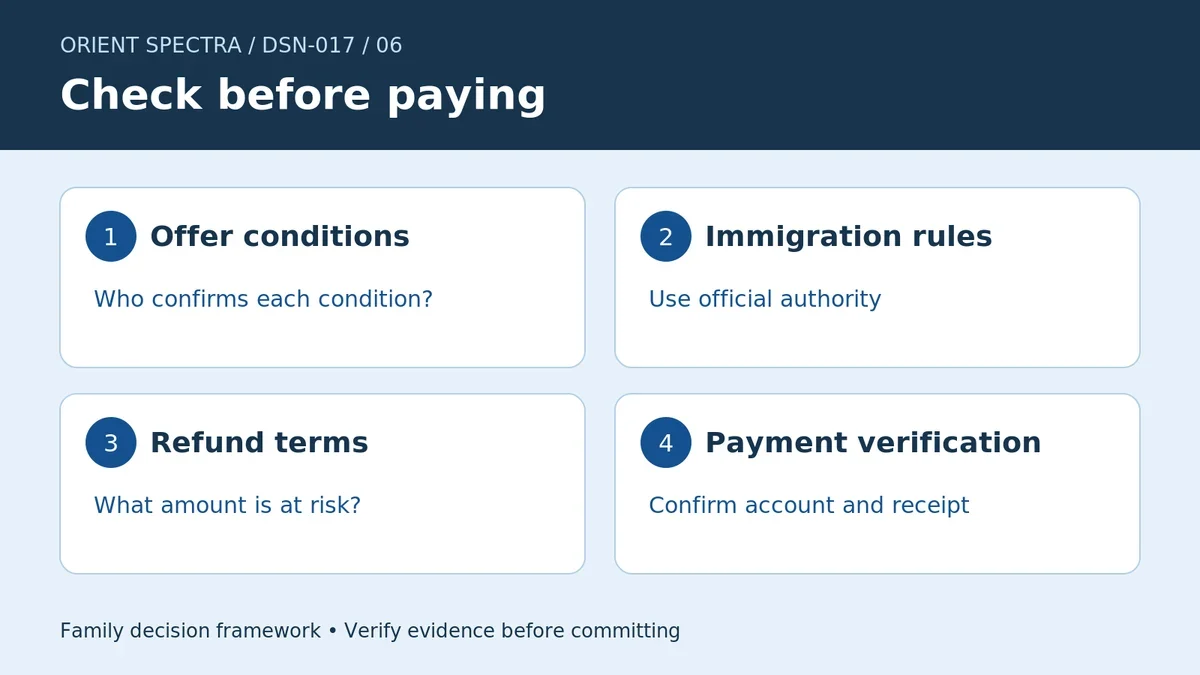
Separate admission, immigration and enrolment decisions. An institution’s offer may contain academic, language, financial or documentary conditions. Read each condition and identify who can confirm that it has been met. An offer is not an immigration decision. Use the destination’s immigration authority to verify the route, documentation and timing applicable to the applicant. Where professional advice is needed, consult an appropriately authorised adviser.
Read the written terms for deposits, withdrawal, deferral and refunds. Ask what happens if admission conditions cannot be satisfied, the intake changes or the student decides not to travel. Record the amount at risk and the dates when commitments become non-refundable. Check whether official protections apply to the particular student and provider. For example, Australia’s Tuition Protection Service describes assistance in certain provider-default circumstances; this is not a blanket guarantee against every financial loss.
Do not pay an unfamiliar account based on a forwarded message. Verify payment instructions through a trusted official channel, keep receipts and store copies of the offer and terms. If a material fact cannot be confirmed, pause the relevant payment rather than assuming it will be resolved later.
How can parents compare two realistic options?
Use the scorecard below for both options. Mark each row confirmed, unresolved or unsuitable. A serious affordability, eligibility or recognition problem should not be averaged away by attractive features elsewhere. Record the source and the date alongside every confirmation. The scorecard is a proposed family decision tool, not an institution rating or prediction of outcomes.
Review the unresolved rows together and assign responsibility for obtaining evidence. If both options meet the essential conditions, use the student’s educational preferences and the family’s agreed risk tolerance to choose between them. If neither option meets the conditions, consider a different intake, programme or funding arrangement.
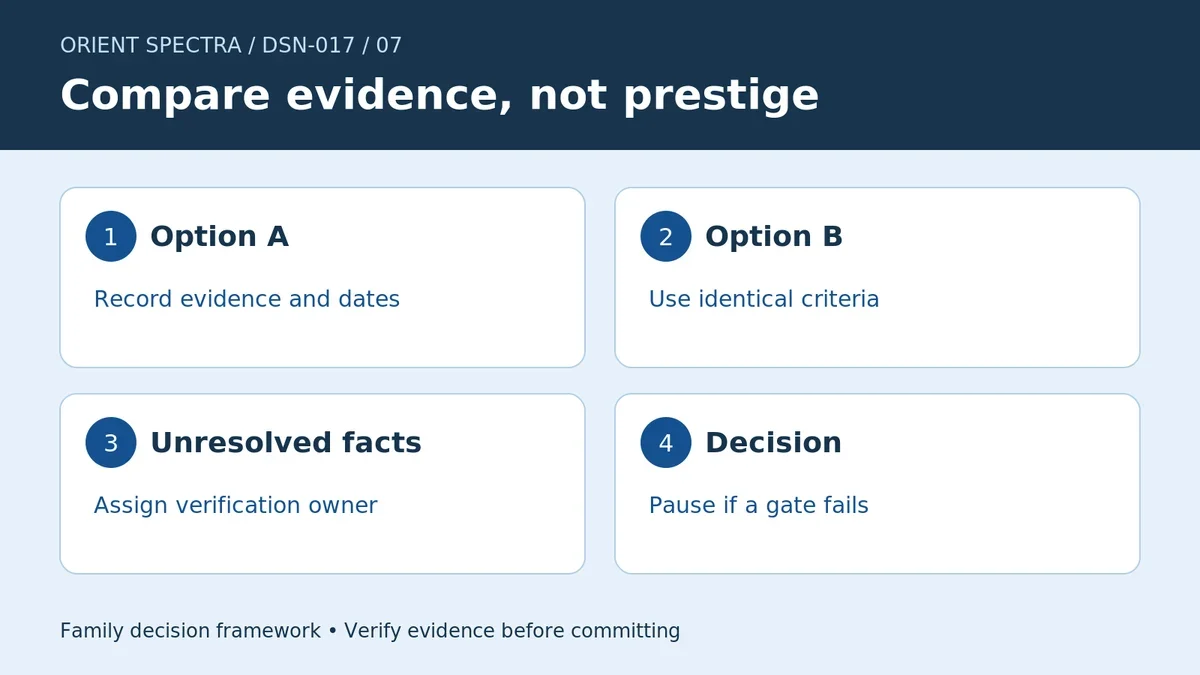
| Criterion | Evidence to obtain | Option A | Option B |
|---|---|---|---|
| Programme fit | Official curriculum and offer | Record status | Record status |
| Eligibility | Written entry and outstanding conditions | Record status | Record status |
| Full cost | Fee basis, housing and cash-flow schedule | Record status | Record status |
| Funding | Confirmed funds and contingency | Record status | Record status |
| Support | Written access and emergency contacts | Record status | Record status |
| Risk | Refund, immigration and recognition checks | Record status | Record status |
Which mistakes are avoidable?
Avoid accepting a deadline quoted by a third party without checking the institution’s own instructions. Avoid comparing different fee periods as if they were identical. Avoid relying on an unconfirmed scholarship, a relative’s immigration experience or a verbal promise of a job. Avoid deciding that a qualification will automatically permit professional practice in another country. Correct each mistake by locating the specific official evidence and recording how it affects the student’s decision.
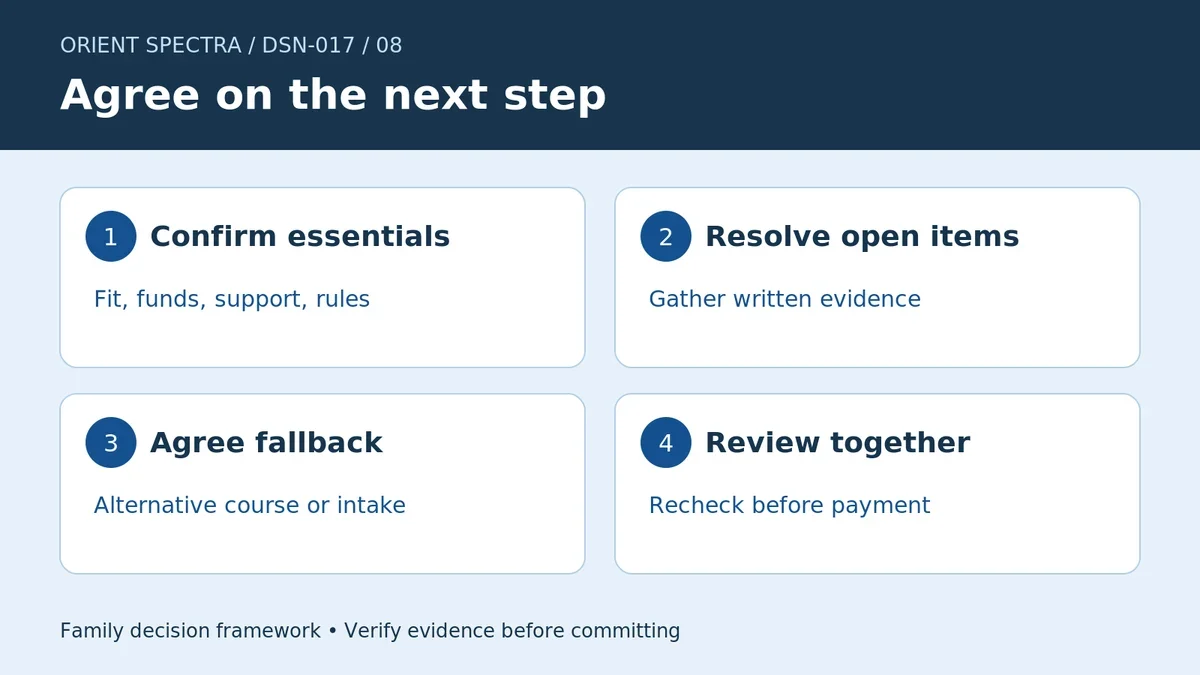
Keep a fallback route. If the intended intake becomes impractical, investigate deferral terms or another realistic programme before committing additional funds. Agree on the point at which the family will pause the plan. This is a practical safeguard against escalating financial commitments simply because earlier payments have already been made.
Family decision checklist
Before making a commitment, confirm the student’s programme fit, academic eligibility and remaining conditions; the full cost and payment calendar; confirmed funding and contingency; written refund and deferral terms; immigration requirements; accommodation and support arrangements; and an agreed alternative if the plan changes. Keep all supporting records together and revisit them before major payments or a change of intake.
Questions parents may ask
Should parents attend a counselling discussion?
A joint discussion can help align the student and family’s expectations. The student should explain their goals and participate in evaluating the options. Parents can bring questions about affordability, evidence and contingencies. Neither should be pressured into an immediate commitment.
What if the student's preferred course exceeds the family budget?
First check the complete cost and confirmed funding. Then compare an alternative course, campus or intake that meets similar academic goals. Do not assume additional debt or future earnings will resolve the shortfall. Discuss financing with the relevant lender or qualified financial adviser.
Can a family use rankings to make the final choice?
Rankings may provide context, but a ranking does not establish individual programme suitability, eligibility, affordability or professional recognition. Compare the actual curriculum, offer conditions and the evidence relevant to the student’s objectives.
When should a family review the decision again?
Review it before accepting an offer, making a significant payment or submitting an immigration application, and whenever a fee, intake, funding arrangement or applicable requirement changes. Keep the previous evidence so that the reason for a revised decision is clear.
Family decision consultation
Prepare the student’s academic profile, intended destination, study level, subject, intake, test status and realistic funding range. Bring the official programme links, offer conditions and unresolved questions to a family decision consultation with Orient Spectra. Review the Course Finder decision guide to help organise the comparison. Do not share passports, bank statements or sensitive records through an unverified enquiry channel.
This guide provides general educational decision support, not individual immigration, legal, tax, financial, admission, scholarship, licensing or employment advice. Verify applicable conditions with the responsible institution, authority or qualified professional. Admission, visa, employment and other outcomes are not guaranteed.