How to compare university offers and choose the right programme
How should you compare university offers?
Indian applicants comparing university offers should first verify admission conditions, the full cost of completing each course, curriculum fit, recognition and personal requirements. Eliminate options that fail an essential requirement, then compare the remaining offers using the same evidence and scoring criteria. Check acceptance deadlines and refund terms before paying, and keep the final decision with the student.
Researched: November 2026.
Start with comparable offers
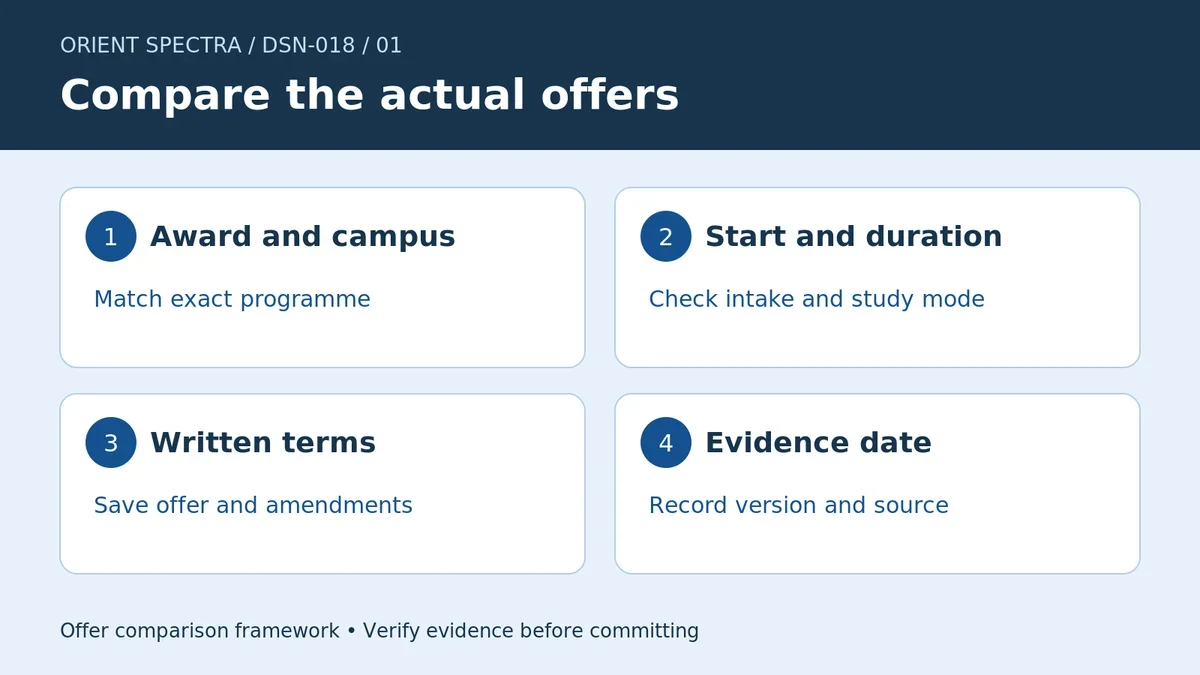
An offer comparison begins when you have written admission decisions for two or more realistic study options. It is different from building an initial shortlist: you now need to decide whether the actual terms of each offer match your expectations. Compare the exact award, campus, mode of study, start date and expected duration. A course listed in an online catalogue may not be the course described in your offer.
Create a folder for each option. Save the offer letter, admission portal record, curriculum, fee schedule and payment policy. Record the date of each document and keep later amendments separately. If an email contradicts a formal offer, ask the institution to confirm which version controls. Do not assume that the most recent message automatically changes the contract.
The comparison is useful even if you have only one offer: assess it against your minimum requirements and decide whether to accept, seek clarification or consider another intake. For an earlier stage of research, consult the Course Finder decision guide. This guide focuses on the terms of actual offers rather than catalogue results.
Which personal inputs matter most?
Write down your previous qualifications, grades, prerequisite subjects, test results, intended occupation, preferred learning format and realistic funding limit. Identify any requirements for accessibility, housing, family responsibilities or location. Separate essential conditions from preferences. A student seeking a regulated profession may need a qualification accepted by a particular regulator; a student seeking a research career may prioritise a dissertation and supervisor fit.
Agree on a minimum academic fit and a maximum affordable commitment before scoring the offers. Discuss the funding range with anyone contributing to your education. Record whether the funding is available now, subject to a loan decision, or dependent on a scholarship that has not yet been confirmed. Your comparison should not depend on money you merely expect to receive.
Set your own priorities before looking at rankings or promotional material. A friend who chose a particular university may offer useful experience, but their circumstances and academic objectives may differ from yours.
1. Verify every offer condition
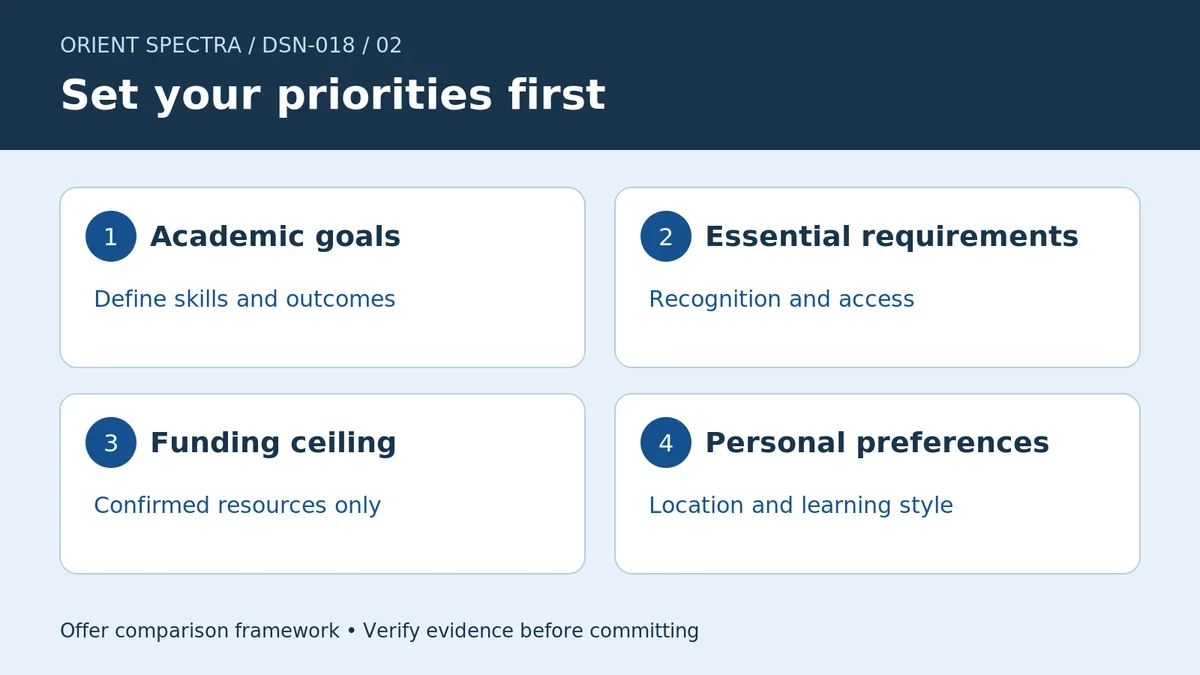
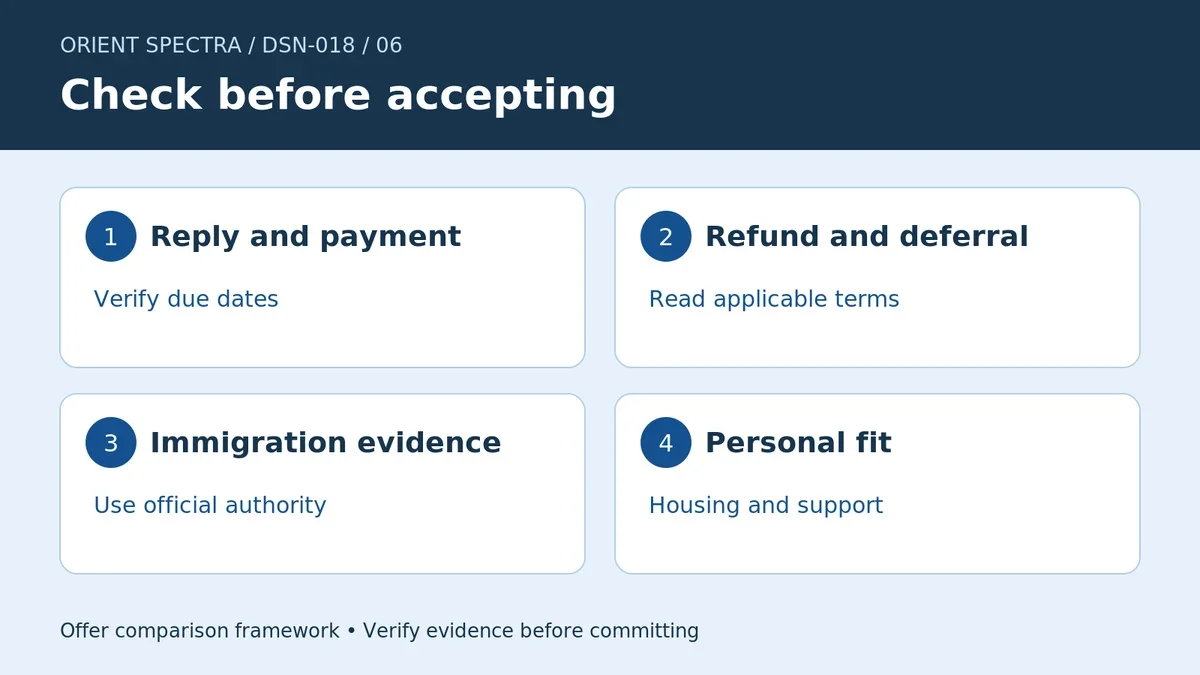
Read the offer line by line. List the required qualifications, grades, English-language evidence, document requirements, payment obligations and response dates. Identify which conditions you have already met and which remain outstanding. Ask admissions staff what evidence they require and when they will confirm that a condition is satisfied.
For example, UCAS distinguishes conditional and unconditional offers in its UK application system. Its offer types guidance and reply guidance explain how offer status and response choices affect commitments within that system. Do not transfer UCAS rules to direct applications, postgraduate admissions or another country without checking the applicable procedure.
If you are waiting for a final transcript or test result, compare the expected delivery date with the stated deadline. Ask about an extension in writing if timing is uncertain. Check whether accepting one option affects your ability to retain another; the answer depends on the application system and the terms you have accepted. Keep admission, enrolment and immigration approval as separate decisions. A university offer does not establish that you meet the immigration requirements.
2. Compare the curriculum and recognition
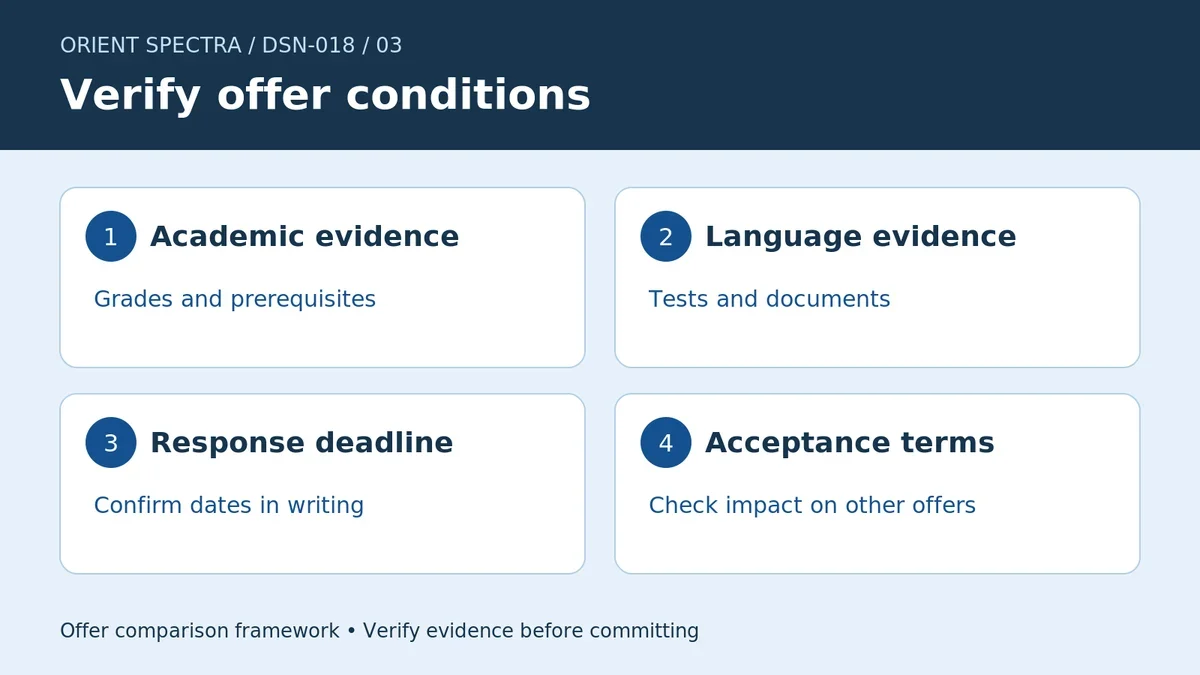
Read the official programme specification, not just the course title. Compare core modules, optional subjects, assessment methods, prerequisites and the final project. Check whether electives depend on availability, timetable or approval. If a placement or research opportunity is central to your decision, ask whether it is compulsory, optional, competitive or subject to separate conditions.
Consider the learning outcomes against your intended career. A broad management programme and a specialist analytics programme may both be attractive but teach different capabilities. Look for evidence of the depth of teaching you need, rather than assuming that a similarly named degree will produce identical skills. EducationUSA’s research guidance is a useful example of researching options by level of study.
Verify recognition separately. For Australia, the Department of Education explains CRICOS registration for providers serving student-visa holders. Registration is not the same as professional accreditation for a particular occupation. If professional practice matters, consult the relevant regulator for the intended jurisdiction, exact qualification and pathway. Ask for written clarification when recognition is uncertain. Do not infer it from a university’s reputation.
3. Calculate comparable full costs
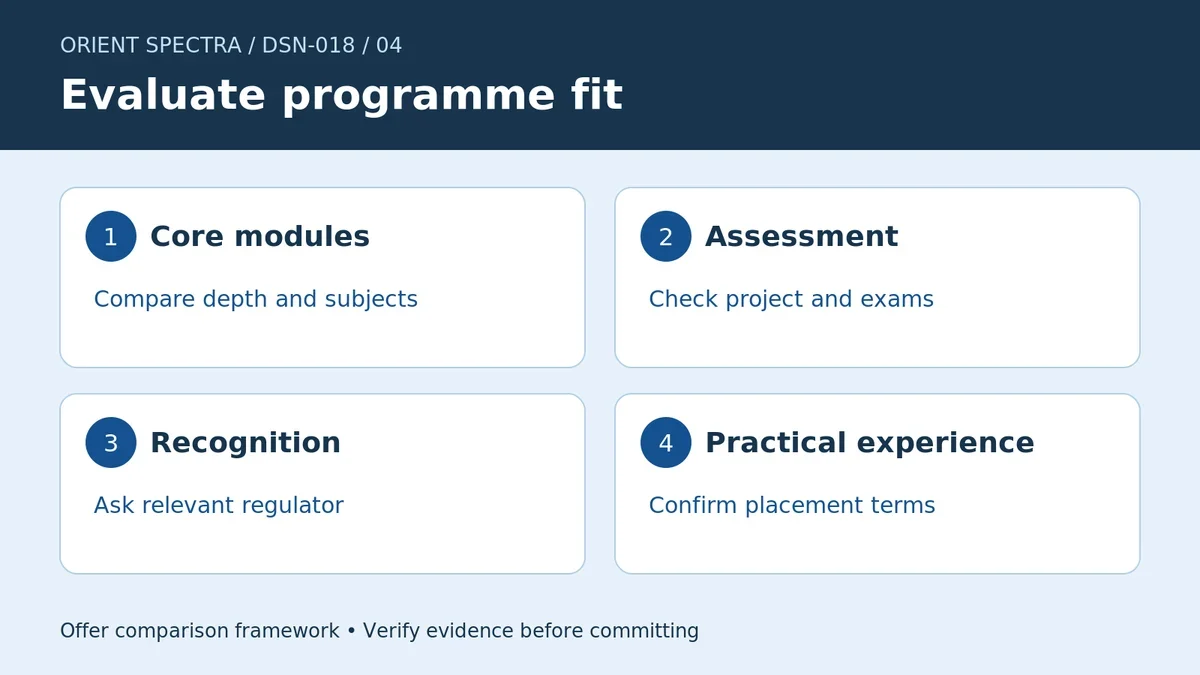
Build a budget covering the entire expected study period. Include tuition, compulsory charges, accommodation, food, transport, insurance where applicable, application and visa-related costs, travel, equipment and a contingency reserve. Record the currency, exchange-rate assumption, fee period and due date. Compare net costs only after subtracting confirmed scholarships or grants with documented conditions.
A hypothetical comparison illustrates the method. Offer A has tuition of 20,000 units and other costs of 12,000 units; Offer B has tuition of 24,000 units and other costs of 6,000 units. Their estimated totals are 32,000 and 30,000 units respectively. The example uses an invented common currency unit, not a real institution’s fee. It shows why tuition alone can reverse the apparent affordability ranking.
Compare cash-flow timing as well as the total. A lower-cost offer may require a large deposit before a loan is disbursed. Ask the lender about interest, repayment and disbursement conditions; do not treat a loan enquiry as approval. Test how the budget changes if exchange rates worsen, costs rise or a scholarship condition is not met. EducationUSA’s graduate financing guidance illustrates the importance of assessing funding sources early. Do not rely on future employment to close a funding gap.
4. Check timing, commitments and personal fit
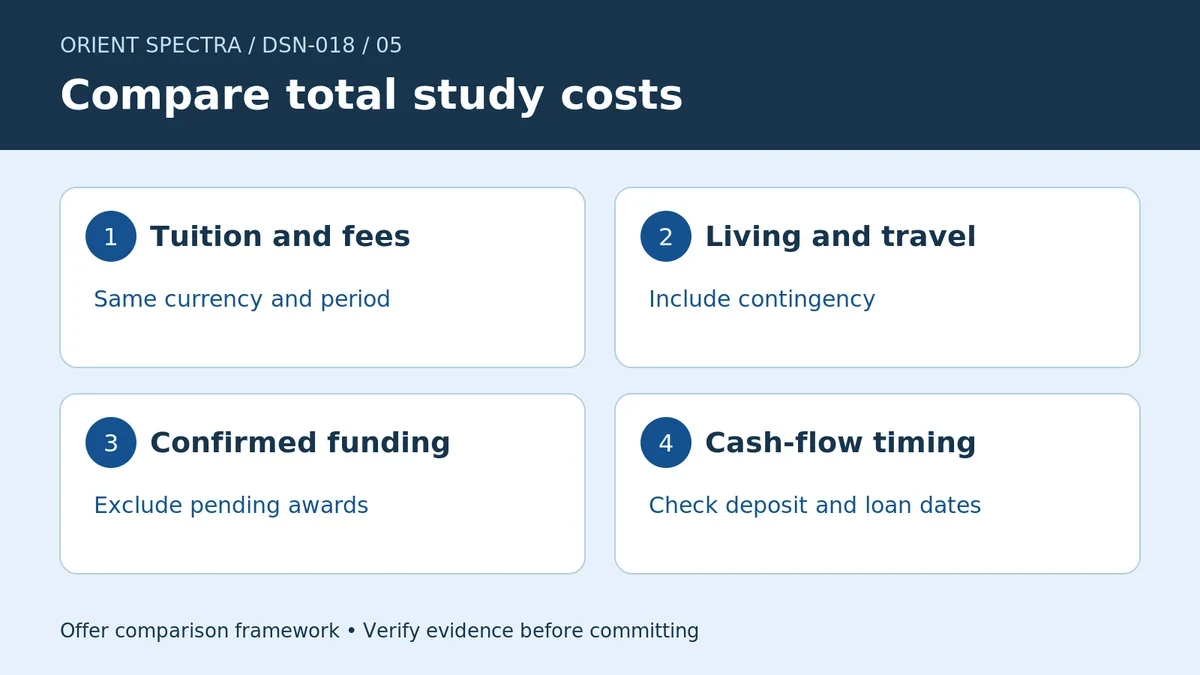
Record the acceptance deadline, deposit deadline, document deadline, intended arrival date and course start. Confirm refund, cancellation and deferral terms before committing funds. Ask what happens if you cannot satisfy a condition or obtain the necessary immigration permission. For Australia, the Tuition Protection Service describes assistance in specified default circumstances; it is not a general guarantee of a refund in every situation.
Check the destination immigration authority’s current instructions for your circumstances. Allow time for documentary preparation, but do not assume a processing duration or predict approval. Keep payment receipts and confirm bank details through an official institutional channel before making a transfer.
Personal fit also matters: compare teaching arrangements, housing availability, travel to campus, student support and accessibility. Ask which arrangements are confirmed and which are simply advertised. For a family discussion about costs and practical support, use the parent decision guide. A student should not choose an option solely because a relative prefers the destination.
How can you score competing offers?
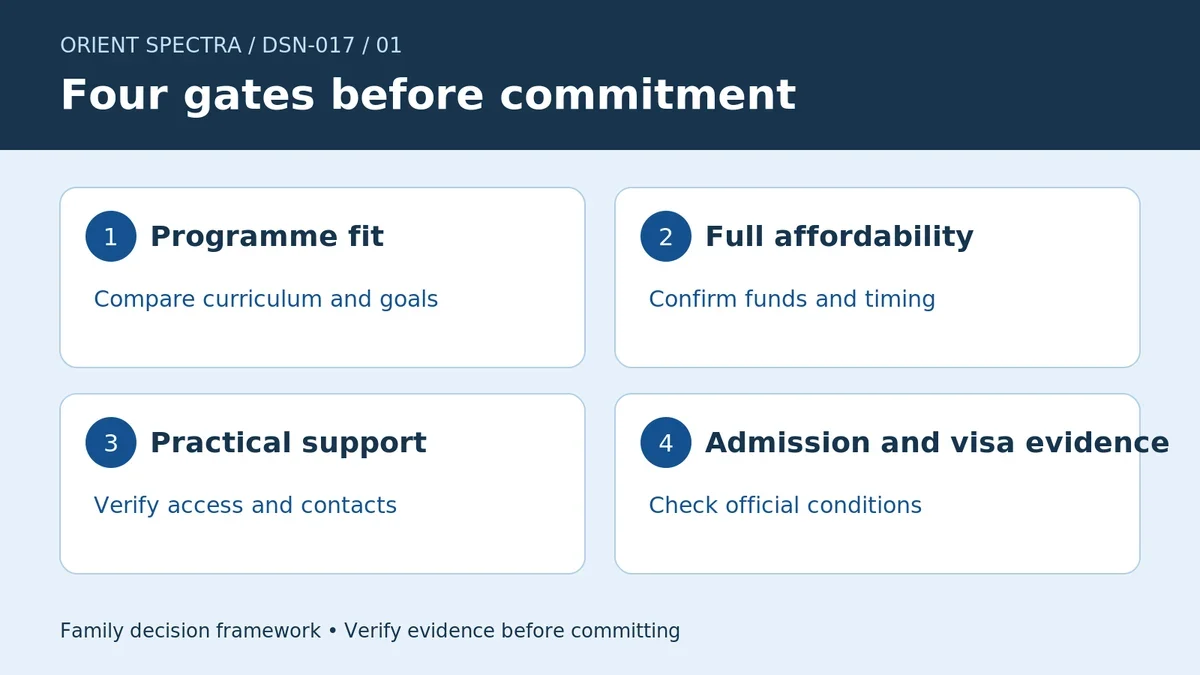
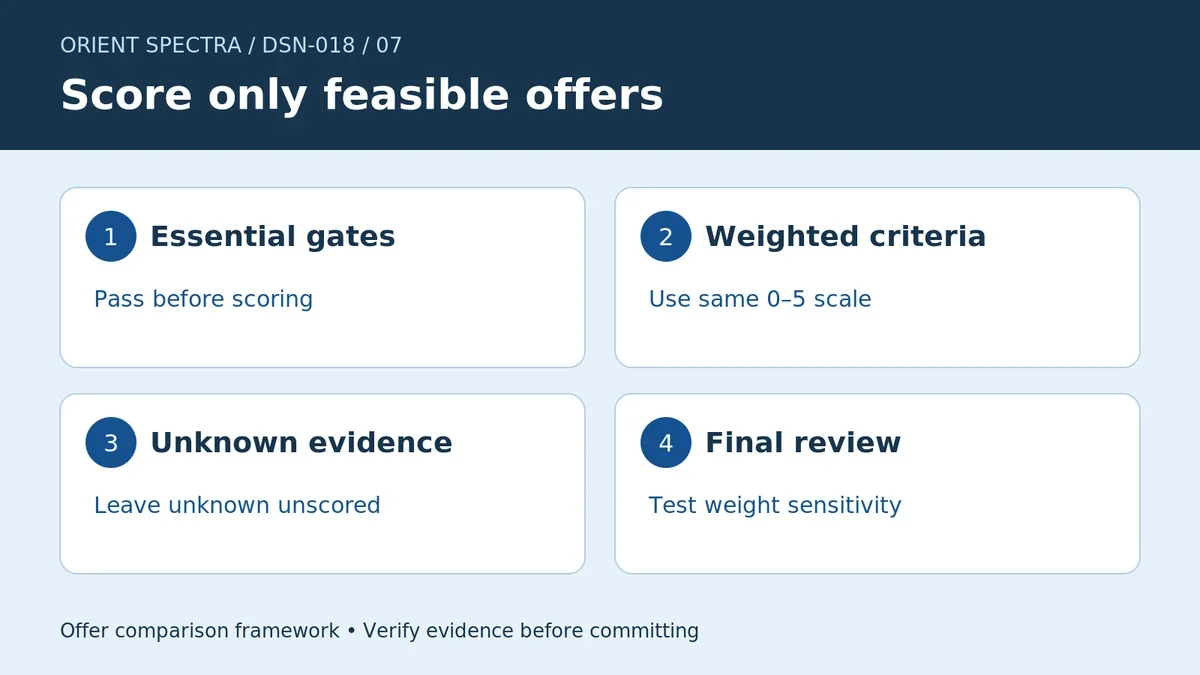
First apply essential gates: realistic eligibility, confirmed affordability, required recognition and feasible timing. Mark each as pass, unresolved or fail. An unresolved essential gate requires evidence before commitment; a failed gate cannot be offset by a high score elsewhere. Then compare the feasible offers using a common scorecard. The weights are illustrative and can be adjusted to your priorities before scoring.
For each criterion assign 0 to 5, where 0 means unsuitable and 5 means excellent fit based on documented evidence. Leave unknown items unscored rather than assigning an average. Multiply each score by its weight and divide by five; add the weighted points to obtain a result out of 100 only when all criteria have evidence. The table supplies suggested weights, not a prediction of educational or career outcomes.
If two complete scores are close, review the highest-weight criteria and test whether a small change in weights alters the result. A numerical difference is not sufficient reason to ignore a material uncertainty. Keep a note of the evidence, date and reason for each rating. Discuss the result with your family or adviser, but retain responsibility for the final decision.
| Criterion | Evidence to obtain | Option A | Option B |
|---|---|---|---|
| Curriculum fit (30%) | Official modules and learning outcomes | Score 0–5 / unknown | Score 0–5 / unknown |
| Affordability (25%) | Full cost and confirmed funding | Score 0–5 / unknown | Score 0–5 / unknown |
| Offer readiness (15%) | Written conditions and deadlines | Score 0–5 / unknown | Score 0–5 / unknown |
| Recognition (15%) | Relevant regulator and qualification | Score 0–5 / unknown | Score 0–5 / unknown |
| Personal fit (15%) | Housing, accessibility and support | Score 0–5 / unknown | Score 0–5 / unknown |
Avoid these mistakes before accepting
Do not compare annual tuition against total-course tuition, mistake a conditional scholarship for available cash, or assume that an unconditional offer means immigration approval. Avoid treating a ranking as evidence of accreditation or reading a generic refund statement instead of the applicable offer terms. If you receive a verbal assurance, request confirmation from the relevant institution or regulator.
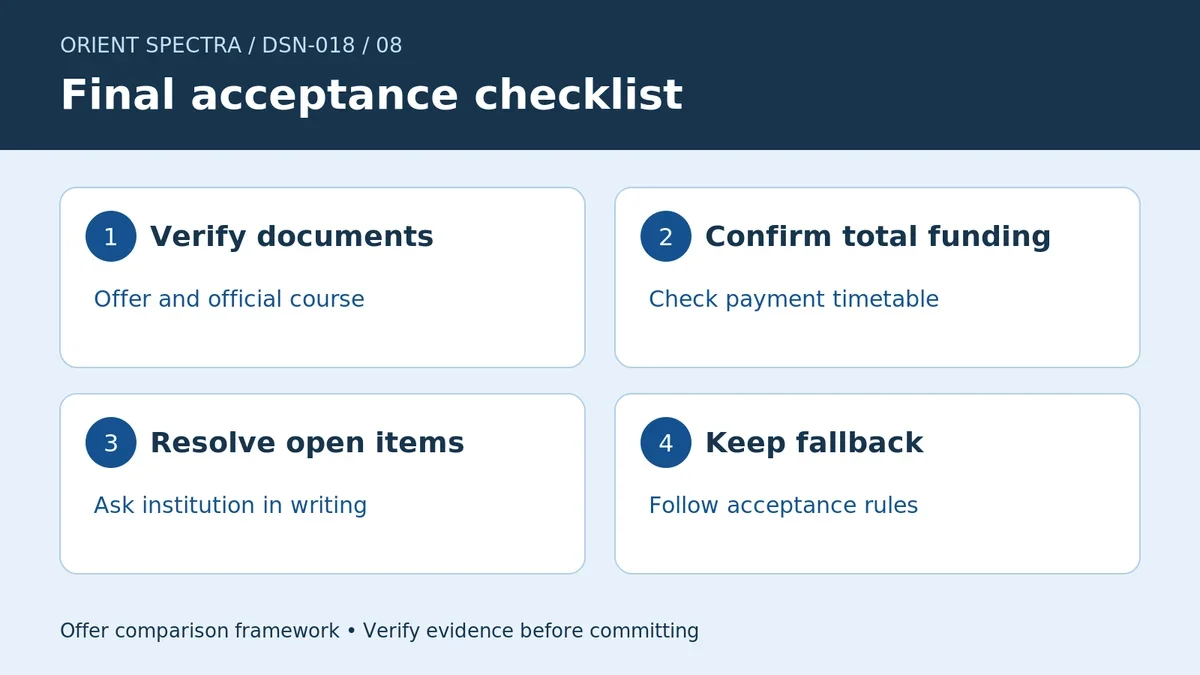
Before accepting, confirm the course and campus; each condition and deadline; complete funding and payment schedule; curriculum and any essential recognition; support arrangements; applicable immigration requirements; refund and deferral conditions; and the effect of acceptance on other offers. Record unresolved issues and who will resolve them. Keep a fallback option where permitted, but do not hold or accept multiple offers in breach of their terms.
Questions about comparing offers
Should I choose an unconditional offer over a conditional one?
Not automatically. Compare the programme’s suitability and the practical likelihood of satisfying the outstanding conditions. Confirm the applicable acceptance rules and deadlines with the institution or application service before making a commitment.
Is a higher-ranked university always the better option?
No. Rankings may provide context, but compare the actual curriculum, required recognition, full costs and your own goals. Check the evidence for the specific award and campus rather than assuming an institution-wide ranking settles the choice.
What if my preferred offer has a scholarship decision pending?
Record the award as unconfirmed and calculate the budget without it. Ask when the decision is expected and whether acceptance or payment deadlines can be adjusted. Only revise confirmed funding once you have written evidence of the award and its conditions.
Can I change my mind after accepting?
The consequences depend on the institution, application system and accepted terms. Read withdrawal, deposit and refund rules before accepting, and ask the admissions office for written clarification if you need to change your choice.
Offer and programme-fit review
Bring your offer conditions, official programme links, intake, academic profile, test status, funding range and completed comparison scorecard to an offer and programme-fit review with Orient Spectra. Identify the questions that need institutional or regulator confirmation before you commit. The review should help you evaluate evidence, not decide on your behalf. Avoid sending sensitive documents through an unverified enquiry channel.
This guide provides general educational decision support, not individual immigration, legal, financial, tax, scholarship, admission, licensing or employment advice. Verify current conditions with the relevant authority, institution or qualified professional. Admission, visas, employment and other outcomes are not guaranteed.