Study-abroad accommodation and pre-departure planning checklist
Researched: 27 November 2026
Before booking accommodation or travelling overseas, Indian students should verify the institution’s arrival instructions, immigration permission and permitted travel dates, the identity of the accommodation provider, the written housing agreement, total upfront and recurring costs, cancellation terms and the arrangements for arriving safely. Keep documentary evidence for each decision. Do not pay an unverified recipient or make irreversible bookings merely because an admission offer has arrived. Requirements vary by destination, institution, housing type and individual circumstances.
1. Separate the housing decision from the travel decision
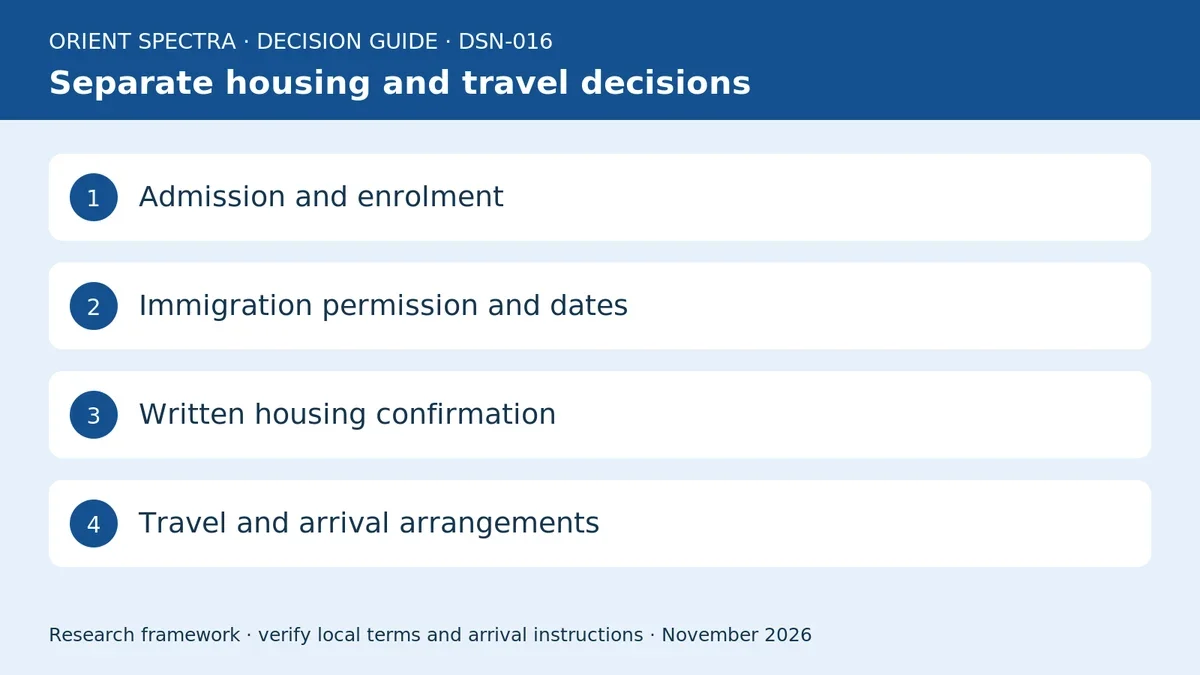
An admission offer, permission to enter a country, a confirmed room and a confirmed flight are different things. Each has its own conditions, deadlines and consequences. A student might have accepted a course offer but still be awaiting immigration permission or accommodation allocation. A reservation request is not necessarily an accepted booking. A flight ticket does not establish permission to enter the destination or transit country.
Start with an arrival plan that records the institution’s official reporting date, permitted arrival window and any outstanding enrolment conditions. Set a separate decision date for housing and travel commitments. Ask the university whether temporary accommodation or late arrival arrangements are possible if the dates do not align. Do not interpret an available room or a cheap ticket as evidence that the other requirements have been satisfied.
2. Record the circumstances that change your checklist
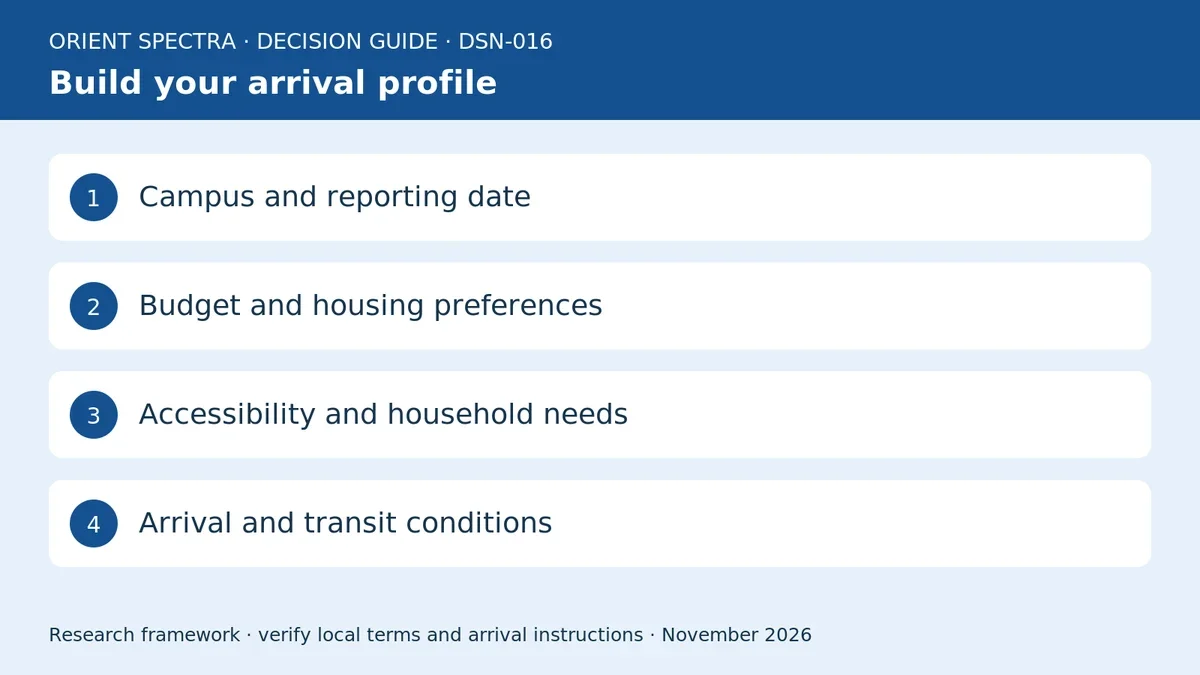
The right housing option depends on more than the monthly rent. Record the campus address, academic start date, intended arrival date, expected length of stay, household budget, accessibility requirements, whether family members will accompany you and your preferences for shared or private facilities. Check whether you must attend activities at multiple sites. A room near one campus may be inconvenient for another.
Record the exact destination and immigration route, including any transit stops, and distinguish the dates you hope to travel from the dates you are permitted to travel. Keep contact details for the institution’s international student team and accommodation office. Where you have medical or accessibility needs, ask the relevant provider about practical arrangements before committing; do not assume a facility or service is available simply because it is advertised generally.
A student travelling alone, a student with dependants and a student arriving before university housing opens may need very different arrangements. Avoid sharing passport numbers, medical records or financial statements in public student groups or unverified enquiry channels.
3. Research housing through official and independently checked sources
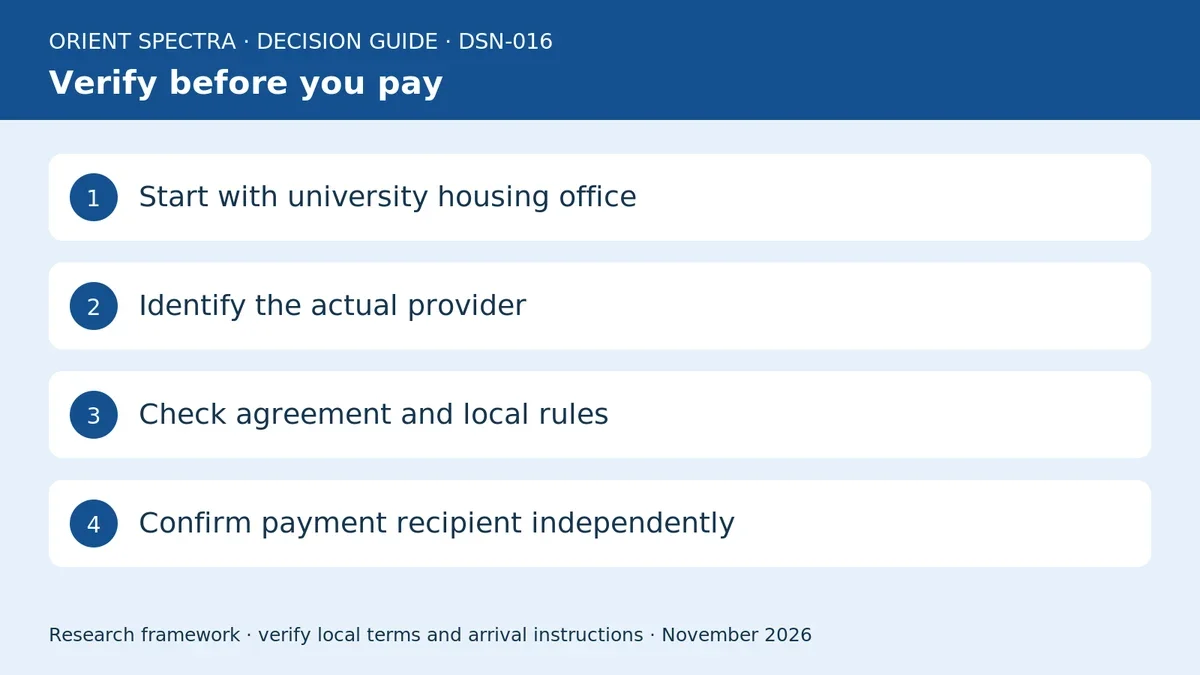
Step 1: Start with your university. Find its accommodation office, allocation process, eligibility rules, deadlines and arrival instructions. If university-managed accommodation is unavailable, ask which private-housing resources it recommends. A recommendation is not a guarantee of an individual property or contract.
Step 2: Identify the actual provider. Establish who owns, manages or is authorised to let the accommodation. Check the address, official website, written terms and independently obtained contact information. Ask for a viewing or an appropriate verified alternative. A photograph, messaging account or copied university logo alone does not establish identity.
Step 3: Identify the legal arrangement. Ask whether the agreement is a tenancy, licence or another housing arrangement, and check the applicable local rules. For example, the UK Government private renting guidance explains that the type of student housing can affect the tenancy classification in England. Its deposit protection guidance describes protection for applicable assured periodic tenancies. Do not transfer these rules to every student hall, licence, country or jurisdiction.
Step 4: Obtain written terms before payment. Record the room, dates, total charges, services included, payment recipient, deposit treatment, cancellation and refund rules. Independently confirm the payment instructions with the provider. If a different account or payment link appears unexpectedly, stop and verify it using a known contact channel.
Step 5: Keep an evidence file. Save the dated agreement, payment receipt, booking confirmation and any clarification. Record what remains conditional. Recheck the arrival instructions shortly before travelling rather than relying on a screenshot taken months earlier.
4. Compare accommodation options using consistent criteria
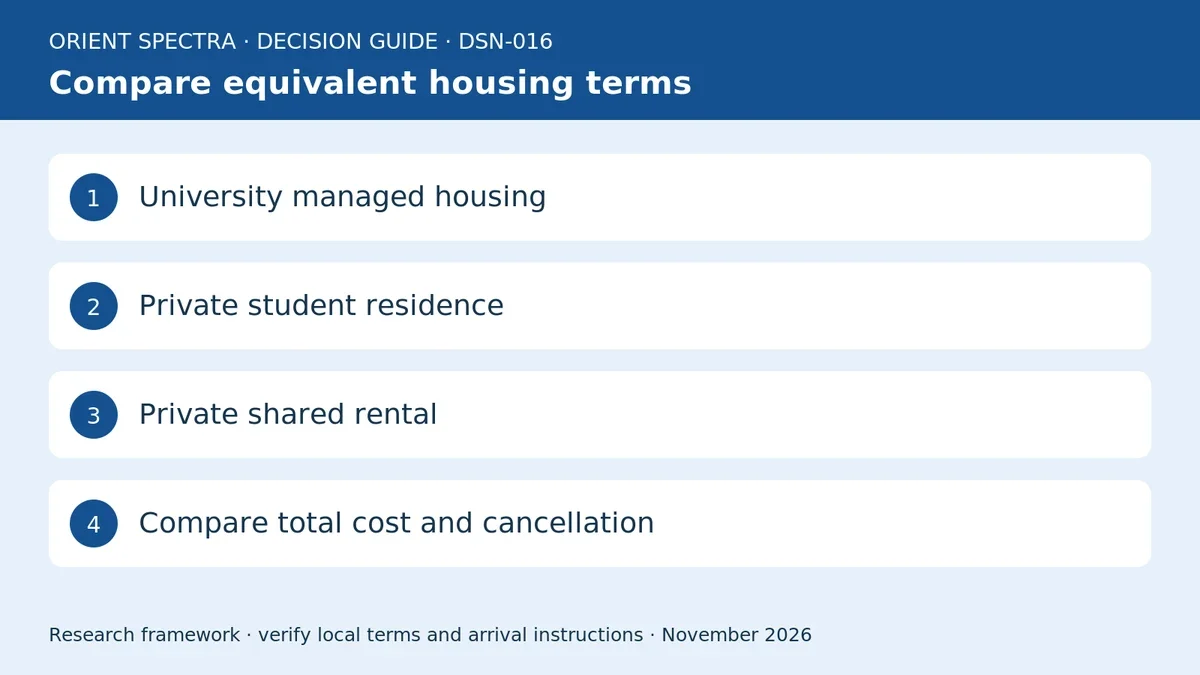
The following comparison is a planning framework, not a claim that any option is available at a particular institution. Ask each provider the same questions and compare written responses.
| Criterion | University-managed housing | Private student residence | Private shared rental |
|---|---|---|---|
| Booking route | University housing office | Verified operator | Verified landlord or agent |
| Eligibility and availability | Check allocation rules | Check room and student conditions | Check occupancy and agreement terms |
| Upfront payment | Confirm instalment and deposit terms | Confirm fees and refund terms | Confirm deposit, rent and guarantor terms |
| Recurring charges | Check included services | Check bills and service charges | Check responsibility for utilities |
| Arrival | Confirm move-in slot and keys | Confirm reception and late check-in | Confirm handover and access |
| Cancellation | Read allocation agreement | Read operator contract | Read tenancy or licence terms |
For each option, note the travel time to campus at the times you expect to attend, the practical access to shops and transport, and the arrangements for maintaining or repairing the property. Check the exact contract length rather than comparing advertised weekly rents without their billing periods. Ask whether internet, heating, electricity and water are included, and whether there are restrictions or extra charges. Where a guarantor is requested, obtain the written obligations before anyone agrees to act in that role.
5. Estimate the total cost and plan for timing changes
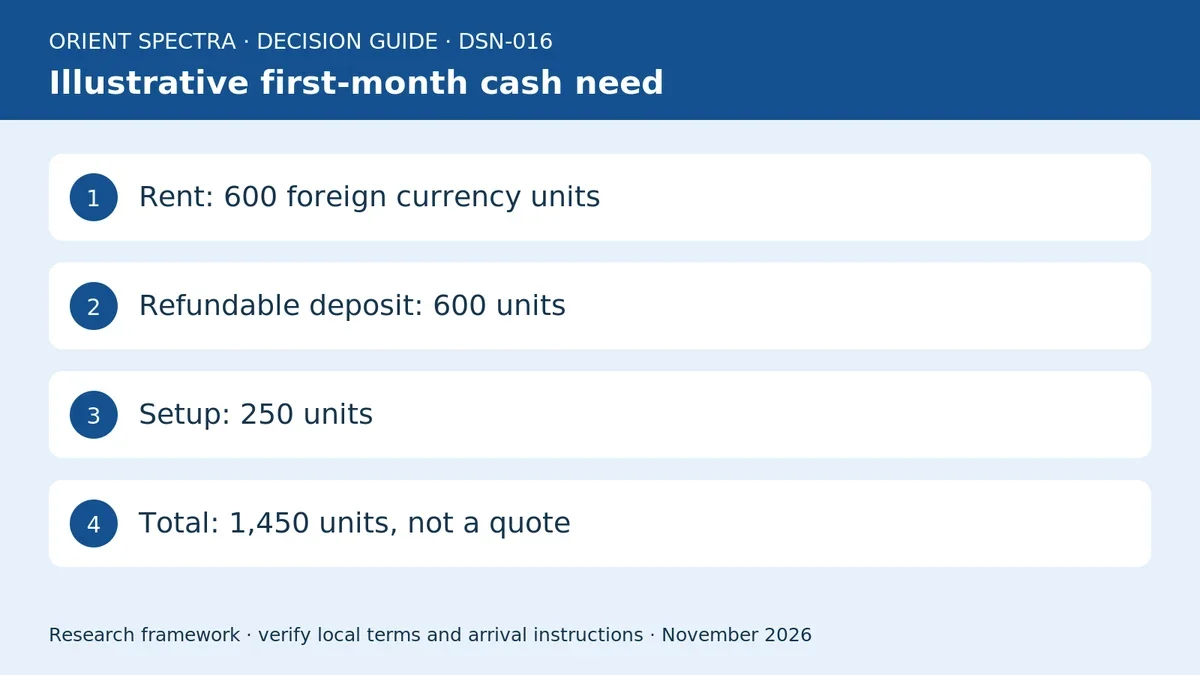
Build a simple household cash-flow worksheet that separates rent, refundable deposits, non-refundable charges, travel, temporary accommodation, food, local transport and essential setup expenses. Convert currency using a dated rate and keep an allowance for exchange-rate movement. Record when each payment falls due, not just the total cost.
For illustration only, consider a room costing 600 units of foreign currency per month, a refundable deposit of 600 units and initial setup expenses of 250 units. The first month’s housing and setup cash requirement would be 1,450 units before other expenses. The deposit is still an upfront cash requirement even if it may later be returned. This is not a market price or an estimate for a particular city. Compare actual written quotes and ensure you can meet the payment schedule without depending on unconfirmed earnings or funding.
Check whether a delay in immigration permission, a deferred course start or a change of campus would affect the booking. Ask for the cancellation deadline and the circumstances in which a refund is available. Compare flexible travel options against their extra cost and keep a fallback for the first few nights if the permanent room cannot be accessed on arrival.
6. Confirm travel permission and arrival arrangements
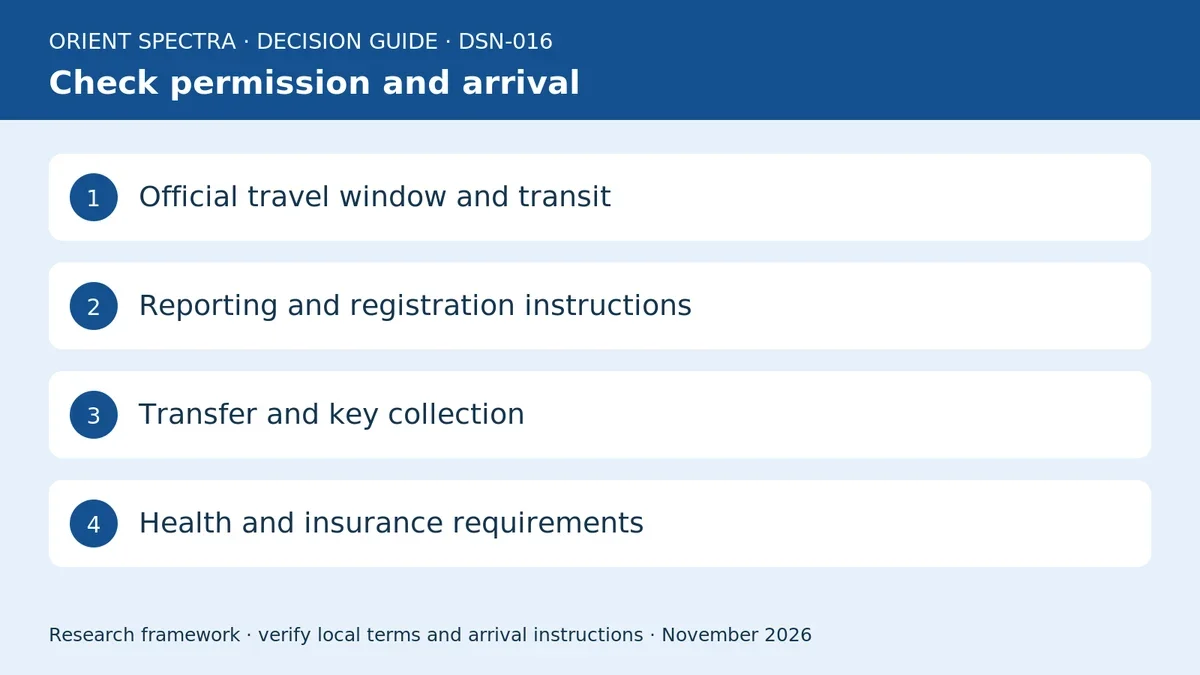
Use the immigration authority’s current instructions for the exact route. As one example, the UK Student visa guidance states that students must not travel before the visa start date, even if the course begins earlier. Check the actual permission and relevant dates for your circumstances. An institution’s welcome email does not replace immigration permission. Other destinations have different rules, so check their own official sources.
Confirm transit requirements for the itinerary, passport validity, any required entry documents, airline baggage and carriage rules, and the university’s reporting instructions. Ask the institution how to report a delayed arrival. Verify the airport or station transfer, address, check-in time and out-of-hours contact directly with the accommodation provider. Share the itinerary with a trusted person through a secure channel.
Review official destination health guidance, insurance conditions and any requirements relating to prescribed medication before departure. Ask an appropriate clinician or authority about your individual needs; do not assume insurance covers every activity or condition. Keep necessary documents and essential medication accessible according to the airline and destination rules, rather than placing all critical items in checked luggage.
7. Prepare for enrolment and avoid preventable mistakes
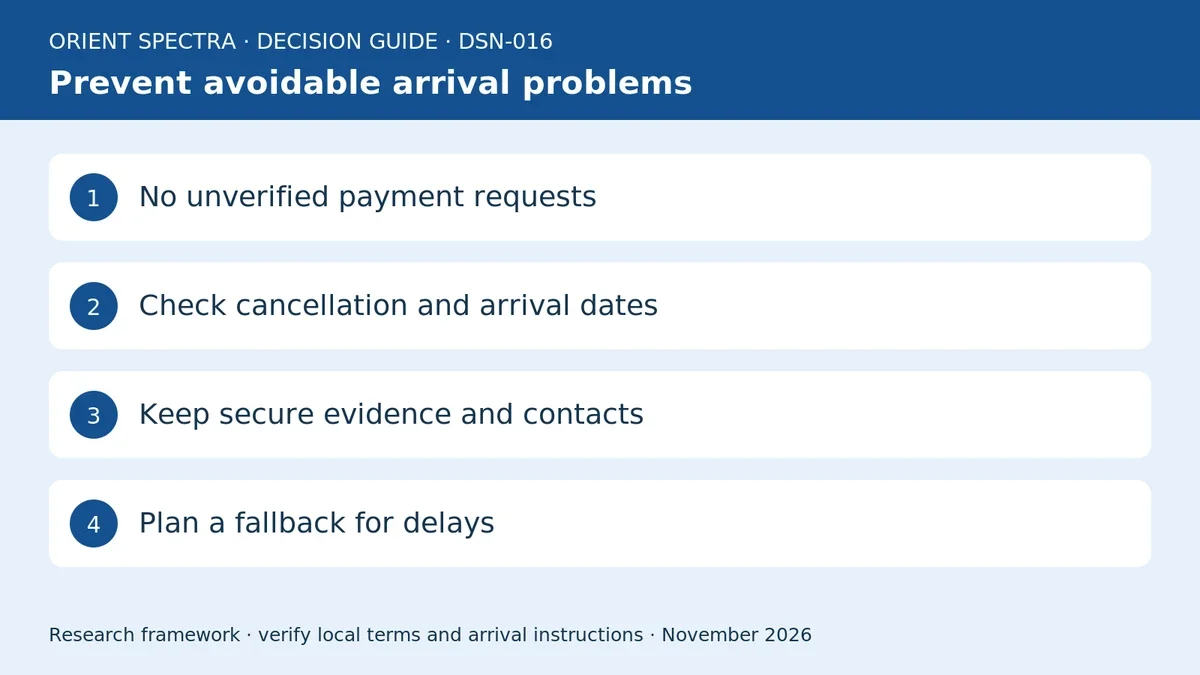
Arrival is not the end of the admission process. The institution may require identity checks, registration, document verification or orientation. For example, the University of Oxford’s before-you-arrive guidance distinguishes initial online registration from completion of registration by the relevant college or department. Treat this as an institution-specific example, not a universal procedure.
Common mistakes include assuming the room is confirmed before receiving written acceptance, paying on the strength of a social-media message, ignoring the contract start date, overlooking cancellation fees, arriving before authorised dates and failing to check late-arrival instructions. Correct each by obtaining current written evidence and identifying the responsible organisation. If the evidence is contradictory, seek clarification directly rather than choosing whichever answer appears most convenient.
For the first day, plan a way to contact the university and accommodation provider, access funds securely, reach your room, obtain essential supplies and report any urgent issue. Save official local emergency and campus support contacts offline. On arrival, inspect the room and record its condition according to the agreement. Report discrepancies through the provider’s stated process and keep copies of correspondence.
8. Practical pre-departure checklist
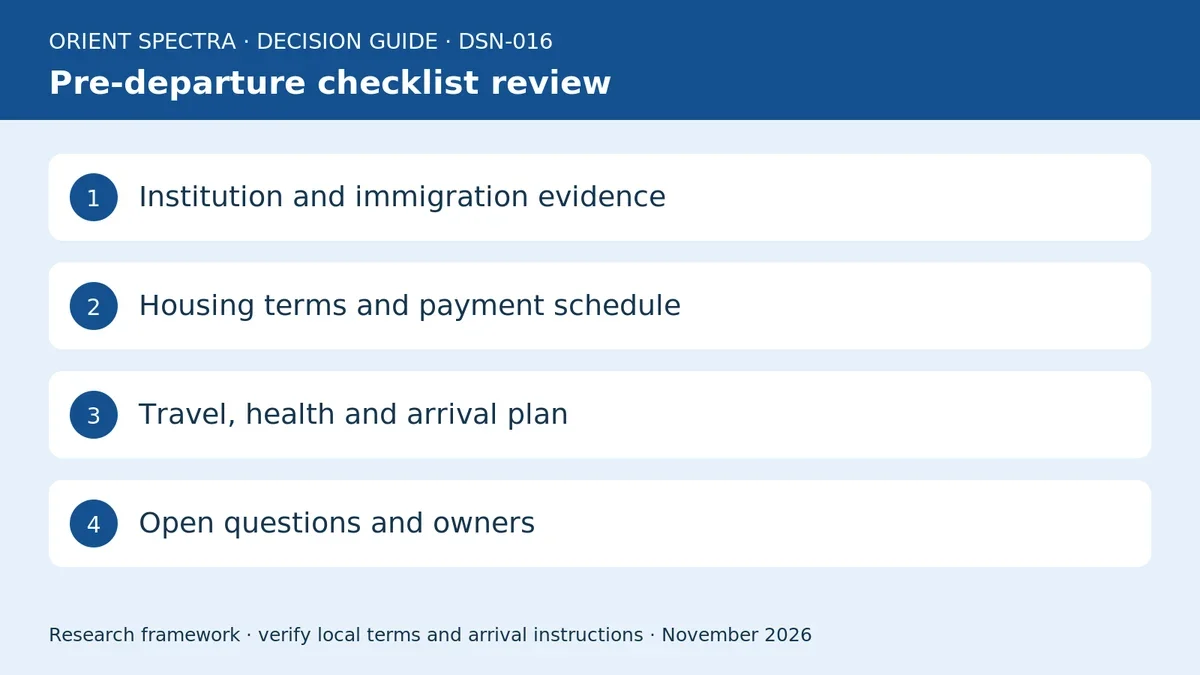
- Institution: confirmed course, campus, reporting date, registration instructions and official international support contact.
- Immigration: exact route, valid permission, travel window, transit rules and current official evidence requirements.
- Accommodation: verified provider, written agreement, confirmed dates, full cost, deposit and refund terms, payment receipt and keys or check-in plan.
- Budget: upfront cash, recurring expenses, contingency, payment deadlines and independently confirmed funding.
- Travel: itinerary, baggage rules, transfer plan, arrival address and backup accommodation arrangements.
- Health and safety: applicable official guidance, insurance conditions, necessary medication arrangements and emergency contacts.
- Documents: secure copies, original documents where required, relevant confirmations and unresolved items with an owner and deadline.
Treat each item as confirmed, conditional or unresolved. An unresolved item is a reason to ask a question, not a reason to assume approval. Review the checklist with your household and update it when dates, costs or requirements change.
9. Frequently asked questions
Should I book accommodation before receiving my visa?
Check the provider’s cancellation and refund terms, the expected decision dates and the institution’s housing deadlines. If you need to reserve early, understand the financial consequences if travel is delayed or permission is refused. There is no universally suitable booking date.
Is university accommodation always cheaper or safer than private housing?
No universal comparison is justified. Compare written costs, contract terms, location, access, services and verified provider information. Ask the university about its housing support; no provider can guarantee personal safety.
Can I travel immediately after accepting my offer?
An offer alone is not travel permission. Check the destination’s immigration requirements, the dates of any permission, transit conditions and university reporting instructions before committing to an itinerary.
What should I do if the landlord changes payment details?
Pause payment and verify the new instructions through independently sourced contact details. Keep the original agreement and correspondence. Ask the university or relevant local support service for guidance if you suspect fraud.
What if my arrival date changes?
Contact the institution and accommodation provider promptly. Check revised reporting, key collection and cancellation arrangements in writing. Review immigration permission and travel conditions independently.
This guide provides general educational planning information, not individual legal, immigration, financial or medical advice. Local rules and individual circumstances determine the applicable requirements.
Pre-departure checklist review: Prepare your destination, institution, course, intake, planned arrival date, accommodation status and unresolved checklist items before contacting Orient Spectra. Its Official Facts describe pre-departure guidance and accommodation support where applicable. Request assistance organising your next steps. No housing availability, price, safety or travel outcome is promised.