

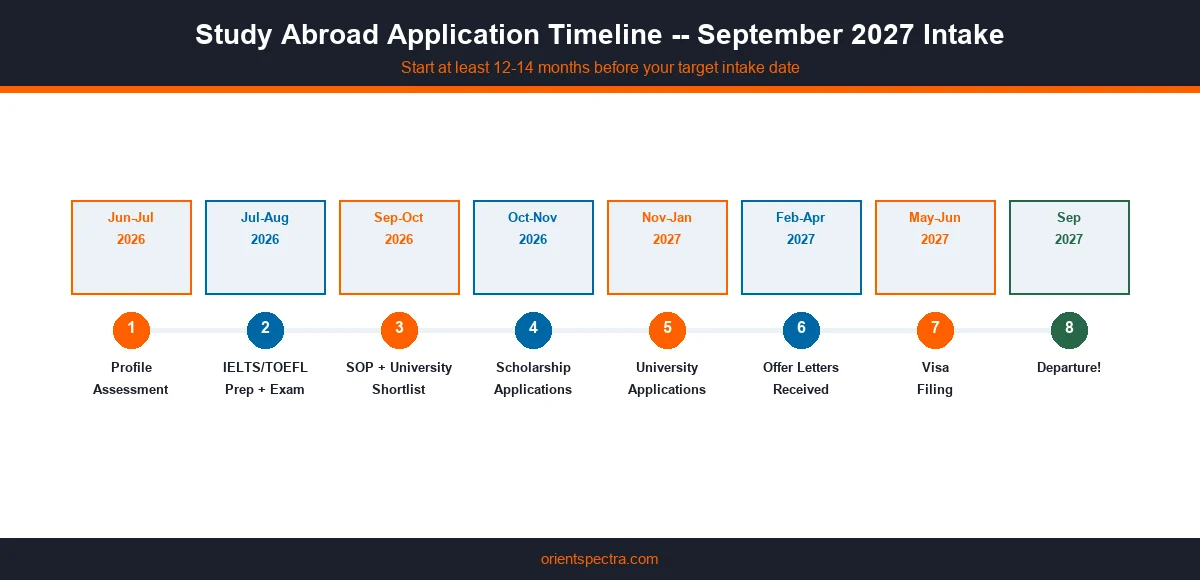
Applying to a foreign university for the 2027 intake is a multi-stage process that spans 8 to 14 months depending on the destination. It involves country-specific application portals with different submission requirements, document authentication processes that vary by destination, standardized test scores that must be taken months in advance, Statement of Purpose drafting that requires weeks of revision, and visa coordination that begins before the application process is complete.
Indian students who treat the university application as a single event, a form submission followed by a wait, consistently miss scholarship deadlines, submit documents in incorrect formats, or run out of time for visa filing. In 2027, with competition for September intake seats at UK, USA, and Canada universities at historic highs, process discipline is not optional; it is a prerequisite for a successful application outcome.
This guide walks through the complete university application process for Indian students, stage by stage, with specific 2027 requirements for each major destination, common mistakes to avoid, and the exact support Orient Spectra provides at each stage.
Key Takeaways
- The application process has 7 stages: profile assessment, test preparation, SOP writing, LOR collection, portal submission, document authentication, and post-offer action.
- Document authentication requirements differ by country Germany mandates APS certification; USA graduate programs often require WES evaluation.
- A strong SOP must tell a coherent narrative connecting past academics, work experience, and future career goals not simply list qualifications.
- Applying to universities in multiple countries simultaneously is strategic for strong profiles and maximizes admission options.
- Post-offer steps including CAS letter, visa application, and accommodation must begin immediately to avoid losing the offer or missing visa timelines.
Stage 1 – Profile Assessment: The Foundation Before Any Application
Every successful study abroad application in 2027 begins not with form-filling but with a structured student profile assessment that establishes a Safe-Match-Reach university shortlist grounded in the student’s actual academic profile, test scores, work experience, budget, and career goals. Skipping this step and applying directly to aspirational universities based on rankings or peer advice is the most expensive mistake in overseas education costing students their application fees, time, and in many cases a full intake year.
The profile assessment outputs a shortlist of 6 to 10 universities distributed across Safe (high probability of admission), Match (competitive but realistic), and Reach (ambitious but possible) tiers. This framework ensures that every application in the portfolio has a strategic purpose, and that the student has strong alternatives regardless of how competitive universities respond.
Stage 2 – Standardized Test Preparation and Scores
Before applications open, most destinations require proof of English language proficiency and, for some programs, subject-specific aptitude scores. Test preparation should begin 4 to 6 months before the target exam date, and the exam itself should be completed 2 to 3 months before the first application deadline to allow time for re-attempts if the initial score falls short.
Orient Spectra offers IELTS coaching and TOEFL coaching at all six branches, and German language coaching for students targeting German-medium programs at public universities in Germany. IELTS and TOEFL coaching at Orient Spectra is included in the standard service fee and is not charged as an add-on.
Language and Test Requirements by Country – 2027
| Country | Language Test | Minimum Score | Additional Test Required | Preparation Start |
| UK | IELTS / TOEFL | IELTS 6.0-6.5 / TOEFL 80-90 | None for most programs | 6-8 months before deadline |
| Germany | IELTS or German B2/C1 | IELTS 6.0+ or German B2-C1 | APS Certificate (mandatory) | 9-12 months before intake |
| USA | TOEFL / IELTS | TOEFL 90+ / IELTS 6.5+ | GRE 310+ / GMAT 650+ | 8-10 months before deadline |
| Canada | IELTS | 6.5 overall, no band below 6.0 | None for most programs | 6-8 months before deadline |
| Australia | IELTS / PTE | IELTS 6.0-6.5 / PTE 58-65 | None for most programs | 6-8 months before deadline |
| Ireland | IELTS | IELTS 6.0-6.5 | None for most programs | 6 months before deadline |
| France | IELTS / DELF | IELTS 6.0+ or DELF B2 | Campus France process | 8-10 months before intake |
Stage 3 – Statement of Purpose (SOP) Writing
The SOP is the single most influential document in any international university application. It is the only place in the application where the student speaks directly to the admissions committee explaining not just what they have accomplished but why they are pursuing this specific program at this specific university, and what they plan to do with the degree afterward. A weak SOP with a strong GPA consistently loses to a compelling SOP with a moderate GPA at competitive programs.
Orient Spectra’s SOP support involves a structured drafting process: initial goal-mapping session, first draft by the student, detailed counsellor review and feedback, second and third drafts with iterative refinement, and final proofreading. The complete process typically takes 3 to 4 weeks. Each SOP is customized for each university and program on the shortlist. A single generic SOP sent to all universities is one of the most common and most damaging application mistakes.
What Makes a Strong SOP in 2027
- Opens with a specific, concrete incident or professional problem that sparked your interest in the field not a generic statement about globalization or aspiration.
- Connects specific undergraduate courses, projects, or research directly to named modules and faculty research areas in the target Masters program.
- Frames work experience in terms of professional growth, technical skills built, and the specific gaps that the Masters program will address.
- Addresses academic gaps, backlogs, or low CGPA directly and briefly an honest one-sentence explanation is far stronger than silence.
- Articulates a precise post-graduation career plan linked to the host country’s job market, specific industries, or return to India with globally competitive skills.
- Each university version includes program-specific references named faculty, research groups, or curriculum modules that justify choosing this institution.
Stage 4 – Letters of Recommendation (LOR)
Letters of Recommendation are the third-party validation of a student’s academic capability, professional character, and growth potential. Unlike the SOP, which comes from the student, LORs come from professors, research supervisors, or direct line managers who can speak to specific, observed experiences with the applicant. Universities use LORs to cross-check claims made in the SOP and assess whether the student’s self-reported strengths are corroborated by credible external sources.
The most effective LORs for 2027 applications are specific and quantified: they name the course or project the recommender supervised, describe the student’s specific contribution or insight, compare the student’s performance to peers, and conclude with a concrete recommendation tied to the specific program being applied to. Generic LORs written by professors who barely know the student stating only grade and attendance are the most common LOR weakness Orient Spectra identifies in student document reviews.
Stage 5 – Application Portals by Destination
Each major study destination uses a different application portal or process for Indian students, and understanding these systems is critical to submitting complete, correctly formatted applications before deadlines.
United Kingdom
Apply to United Kingdom – Portal: UCAS (ucas.com) for undergraduate; direct university portals for most postgraduate (Masters) programs. Key Deadline: January 15, 2027 for most UK universities; October 15, 2026 for Oxford, Cambridge, and medicine programs. Up to 5 choices through UCAS for undergraduate. Each postgraduate Masters program has its own portal and deadline. Orient Spectra tracks all deadlines for students’ shortlisted universities. Offer turnaround typically 4 to 8 weeks after application.
Germany
Apply to Germany – Portal: Uni-Assist (uni-assist.de) for most public universities; direct portals for some private universities and TU Munich. Key Deadline: May to July 2027 for most universities for Winter 2027 semester; APS must be completed before submission. APS certificate is a prerequisite to begin the APS process by October 2026 for Winter 2027 intake. Uni-Assist charges a processing fee per application. Blocked account of EUR 11,208 required alongside application.
USA
Apply to USA – Portal: Common App (commonapp.org) for undergraduate; direct graduate portals for MS, MBA, and PhD programs. Key Deadline: November 2026 (Early Decision) to February 2027 (Regular Decision) for most programs. Apply to 8 to 12 universities across Safe-Match-Reach tiers. GRE or GMAT scores must be sent directly from the testing body to each university not submitted through a third-party portal. SEVIS fee paid after I-20 issuance.
Canada
Apply to Canada – Portal: Direct university portals; OUAC (Ontario Universities Application Centre) for Ontario undergraduate programs. Key Deadline: February to March 2027 for September 2027 intake at most Canadian universities. SDS stream applicants submit IELTS scores, GIC confirmation, and LOA together for 20-day processing. Non-SDS applicants follow the standard study permit process (8-12 weeks). Indicate co-op preference in application to maximize PGWP-eligible work experience.
Australia
Apply to Australia – Portal: Direct university portals; IDP Australia also facilitates applications. Key Deadline: November 2026 for February 2027 intake; April 2027 for July 2027 intake. Universities issue CoE (Confirmation of Enrolment) after accepting application and receiving enrollment deposit. CoE is required to apply for a Subclass 500 student visa. GTE statement submitted with visa application.
Stage 6 – Document Authentication and Verification
International universities require authenticated copies of academic documents. The authentication requirements differ significantly by destination and are one of the most frequently misunderstood aspects of the application process for Indian students.
- Germany (APS) – All Indian academic documents must be verified through the APS (Academic Evaluation Centre) India in New Delhi. This is a mandatory prerequisite for all Indian applicants to German universities since September 2022, with no exceptions.
- USA (WES) – Many US and Canadian graduate programs require World Education Services (WES) evaluation of Indian degree transcripts to convert them to the US GPA scale. WES evaluations take 7 to 15 business days and must be ordered directly through wes.org.
- UK – Most UK universities accept attested copies from the university registrar. Some programs may request apostilled documents or Direct Communication (DC) with the issuing Indian university to verify transcripts.
- Canada – Canadian universities typically accept official transcripts sent directly from the Indian university in sealed envelopes. SDS applicants must provide IELTS score reports directly from the British Council or IDP.
- Australia – Certified copies of mark sheets and degree certificates are typically sufficient. Some universities request direct transcript submission from the Indian institution’s international office.
Stage 7 – After the Offer Letter
Receiving an offer letter whether conditional or unconditional marks the midpoint of the application process, not the end. After an offer, students must decide between multiple offers if they hold more than one, meet any stated conditions (minimum final CGPA, final exam results, English score), pay the enrollment deposit within the university’s deadline, and begin the visa preparation process which often runs in parallel with the final stages of admission.
Orient Spectra provides a structured offer comparison framework for students holding multiple offers: comparing course curriculum alignment with career goals, cost of attendance versus scholarship received, post-study work rights by country, and graduate employment rates for the specific program and university combination. This comparison prevents the common error of choosing a university based on ranking alone rather than on the factors that actually determine career outcomes.
Frequently Asked Questions
What is the difference between the September 2027 and January 2028 intake?
September 2027 (Fall or Autumn intake) is the primary intake cycle with the widest course availability, most scholarship funding, and maximum number of available seats at all major universities. January 2028 (Spring, Winter, or Trimester 2 intake) is a secondary intake with fewer course options, significantly reduced scholarship funding at most institutions, and limited availability for competitive programs. Students who miss the September 2027 deadline can apply for January 2028, though the overall outcome quality tends to be lower across destinations.
How many universities should I apply to for a safe outcome?
The optimal number is 8 to 12 universities distributed across Safe (2-3), Match (4-5), and Reach (2-3) tiers. Applying to fewer than 6 universities significantly increases the risk of all rejections and removes negotiating leverage if one or two universities reject without waitlisting. For Germany specifically, 4 to 6 universities is sufficient given the lower rejection rates at public universities but the APS and Uni-Assist process requires additional lead time compared to direct applications.
How important is the SOP compared to my GPA for Masters applications?
Both matter significantly, but the SOP is the differentiator in competitive admission cycles. A student with a 7.0 CGPA and an excellent, specific, well-structured SOP consistently outperforms a student with a 7.8 CGPA and a generic, unfocused SOP at the same universities. Universities use the GPA to determine eligibility but they use the SOP to decide whether they want this specific student. Investing 3 to 4 weeks in multiple reviewed drafts of the SOP is one of the highest-ROI activities in the entire application process.
Can I apply to universities in multiple countries simultaneously?
Yes, and this is the recommended strategy for most Indian students in 2027. Applying to the UK, Germany, and Canada simultaneously for September 2027 maximizes options and gives negotiating leverage when offers arrive. Each country’s application uses different documents, portals, and deadlines, so multi-country applications require careful timeline coordination which is one of the core services Orient Spectra provides to students with multi-country shortlists.
What is the difference between a conditional and an unconditional offer letter?
A conditional offer means the university will confirm your place once you meet specific conditions, typically a minimum final CGPA (e.g., 60% or 6.5/10), a specific English language score by a stated date, or submission of pending final transcripts. An unconditional offer means all conditions are already met and your place is fully confirmed. Do not pay the enrollment deposit or begin visa preparation on a conditional offer until you have a realistic plan to meet the stated conditions before their deadline.
Can I defer my admission to the next intake after receiving an offer?
Many universities allow one deferral per application, but policies vary significantly. UK universities generally allow a single deferral to the next intake (January or September) for valid reasons submitted in writing. US universities are more restrictive; some programs explicitly prohibit deferral, while others allow it case by case. Canadian universities are similarly selective. Deferral requests must be submitted before the enrollment deposit deadline. Orient Spectra drafts formal deferral request letters for students who need them.
What happens if I am rejected by all universities I apply to?
This outcome is rare when applications are based on a proper profile assessment and distributed across a Safe-Match-Reach shortlist. If it does occur, Orient Spectra conducts a debrief session reviewing each rejection, identifying the specific gap that led to it, and developing a targeted reapplication strategy for the next intake (January 2028 or September 2028). The debrief typically reveals either a profile gap (IELTS score, GPA, missing work experience) or an SOP weakness; both are addressable with a clear improvement plan.
What role does a Letter of Recommendation play in the application?
LORs are the third-party validation of academic and professional capability that universities use to cross-check claims in the SOP. Strong LORs are specific, quantified, and written by people with authority professors who supervised a student’s research, or line managers who directly oversaw the student’s professional work. Generic LORs from professors who only know the student’s grade are the most common LOR weakness in Indian student applications. Orient Spectra counsellors brief recommenders on what effective LOR content looks like for each destination.
Does Orient Spectra’s Hyderabad branch provide full SOP writing and review support?
Yes. Orient Spectra Hyderabad has dedicated SOP counsellors who work with students through multiple drafts across 3 to 4 weeks. The SOP process begins after profile assessment and university shortlisting, typically 7 to 9 months before the target intake deadline. Each SOP version is customized for each university on the shortlist not a single generic document sent to all applications. SOP support is available for all destination countries.
Do the Chennai and Trivandrum branches handle Germany and UK applications with the same expertise?
Yes. Orient Spectra’s Chennai branch has dedicated UK and Germany counsellors with deep expertise in UCAS processes, APS certificate preparation, Uni-Assist portal management, and SOP requirements for both destinations. The Trivandrum branch additionally offers German language coaching supporting students targeting German-medium programs at public universities, the most cost-effective study abroad option available to Indian students anywhere in the world.
Ready to Begin Your Study Abroad Journey?
Orient Spectra’s expert counsellors across six branches: Hyderabad, Kukatpally, Kothapet, Chennai, Bangalore, and Trivandrum are ready to guide you from your first profile assessment to your flight departure. With 21+ years of experience, ICEF accreditation, AIRC Membership, and British Council certification, we bring verified expertise to every student’s application.
Book your free counselling session today at orientspectra.com or call us at +91 9154087870. You can also write to us at digital@orientspectra.com. Walk-ins are welcome at all six branch locations across South India.


